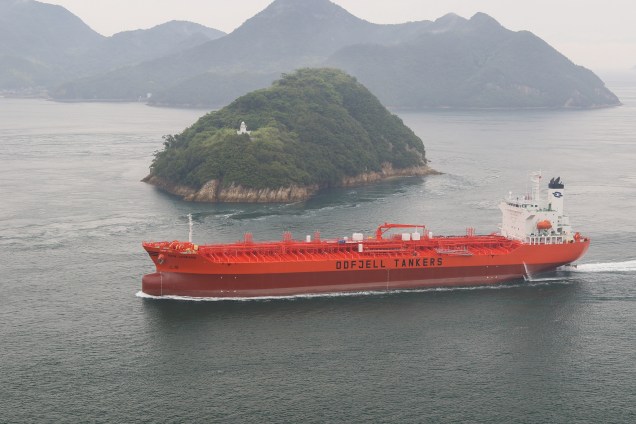
Odfjell has launched the first operational green corridor between Brazil and Europe. “Our chemical tankers are now sailing the 5,000-nautical-mile route between Brazil and Europe with substantially lower emissions. The corridor will operate 12-15 voyages per year, each lasting around 40 days”, states the Norwegian company.
”We have established an offtake of B24 sustainable biofuel blend in Rio Grande to secure long-term fuel availability. The Ports of Antwerp-Bruges, Rotterdam and Rio Grande are working together with our team to advance the green corridor through increased efficiency and optimized port-stay processes.”
“We do this to demonstrate that certified fuel, technology, and infrastructure are already available,” says CEO Harald Fotland. “Through this, we show that sustainable biofuel is a viable option for deep-sea shipping today.”
Fotland emphasizes that this is not a one-off demonstration but a long-term commitment.
“With this corridor, we integrate greener fuel as a new pillar in our decarbonization strategy. We activate the entire value chain to find ways to decarbonize our operations, and we are encouraged that key stakeholders are joining us in this groundbreaking initiative.”
Odfjell has taken independent action—self-funding the project and moving ahead without subsidies.
“By covering the additional cost ourselves, we eliminate the financial element and move directly into operational implementation. It may not be a perfect corridor yet, but a solid start. Its success depends on collaboration across the value chain, and we are committed to developing it further together with relevant stakeholders,” Fotland says.
This includes collaboration with ports to increase efficiency, with customers to maximize capacity utilization, and with fuel providers to increase the influx of green fuels.
In Brazil, the currently available sustainable biofuel quality is the so-called certified B24—a blend of 24% renewable biodiesel derived from waste and 76% VLSFO. Introducing biofuel marks another step in Odfjell’s decade-long work to reduce emissions. “We have already improved our carbon intensity by more than 54% compared to the 2008 benchmark, achieved through a wide range of technical and operational measures.”
The initiative aligns with IMO’s 2030 targets and the EU’s Fit for 55 ambitions, and builds on the 2024 Norway-Brazil MoU to establish a green, transatlantic shipping corridor.
“We hope to inspire broader industry action and welcome continued collaboration with regulators, ports, producers, other ship operators, and customers to accelerate the transition to low-emission maritime transport,” Fotland ends.
The Norwegian Minister of Climate and Environment, Anders Bjelland Eriksen, states:
“We congratulate Odfjell on taking the lead and demonstrating what is possible when business and public authorities cooperate across national borders to reduce emissions. Green shipping corridors over long distances are still in their early stages, and this therefore represents an important first step on the path toward zero emissions. The ocean is the link in trade between Brazil and Norway. This new green shipping corridor is the result of Norway’s cooperation with Brazil on more climate-friendly shipping. We will continue this work with the aim that more vessels can gradually adopt a wider range of low- and zero-emission fuels.”
 IL BIOECONOMISTA