With a new, natural product rich in capsaicinoids, polyphenols, and flavonoids, Evonik aims at helping the dairy industry address two major challenges: nutrient deficiency in early lactation and heat stress. The German company has developed BoruCare® Capsin in cooperation with Heidi Botanicals, a French specialist in plant-based products for livestock. The product has been presented at SPACE 2025 and it will be commercially available in Europe from Q4 2025.
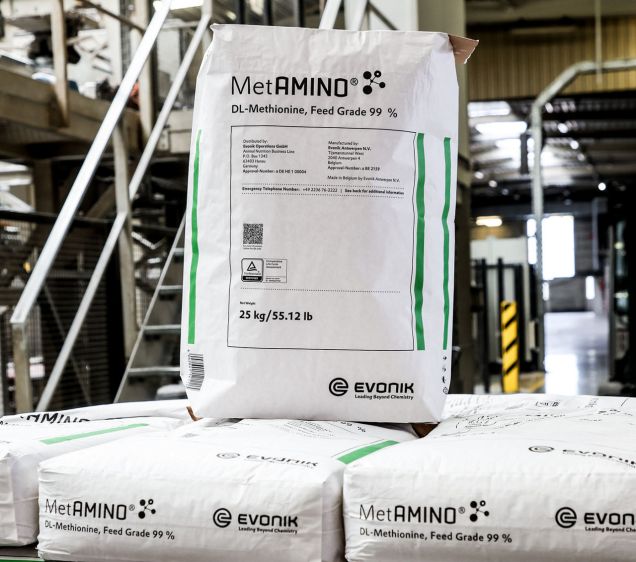
Evonik has introduced a more environmentally friendly 25-kilogram paper bag for MetAMINO® (DL-methionine) by eliminating the plastic film layer. This change not only benefits customers with easier disposal options but also aligns with the EU’s new ‘Packaging & Packaging Waste Regulation’ (PPWR) aimed at enhancing recycling efforts.
Rhamnolipid plant opening ceremony, from left: Yann d’Hervé; Head of Care Solutions Business Line – Nicole Rudningen; Head of Production and Technology, Care Solutions Business Line – Harald Schwager Deputy Chairman of the Executive Board, Evonik Industries AG – Christian Kullmann; CEO, Evonik Industries AG – Peter Bakker President & CEO World Business Council for Sustainable Development (WBCSD) – Barbara Wolf Ambassador of the Federal Republic of Germany to the Slovak Republic – Johann-Caspar Gammelin Member of the Executive Board | President Nutrition & Care – Miroslav Havlík, General Manager, Evonik Fermas s.r.o. Source: http://www.evonik.com
Evonik officially inaugurated its new sustainable biosurfactant plant together with key customers in Slovakia. The triple-digit million-euro facility is the first worldwide to manufacture industrial-scale quantities of rhamnolipid biosurfactants. These exceptionally high-quality, sustainable biosurfactants are already transforming the cleaning, beauty and personal care industries and have huge potential in many other applications.
Evonik is strengthening its offering of botanical extracts and natural actives by bringing its expertise together under a newly established business segment. The Botanicals & Natural Actives segment draws on expertise built up through legacy products together with a series of recent acquisitions. Evonik – the German company claims – can now better meet the growing demand for botanical extracts and claim-substantiated natural actives, which are supported by its recently established Skin Institute.
Evonik and Uniper officially launched the Technical Options for Thermal Energy Recovery (TORTE) project in Gelsenkirchen. As one of the first phases of Evonik’s ‘Herne Green Deal’ to sustainably transform the Herne chemical site, the TORTE project will feed industrial waste heat from isophorone production into the district heating network. Around 1,000 homes in the Ruhr region will be supplied by the end of 2024.
Evonik has launched a non-animal-derived squalene suitable for vaccines and other pharmaceutical applications. PhytoSquene® is the first known amaranth oil-derived squalene on the market for use in adjuvants in parenteral dosage forms. It meets the demand for a secure commercial supply of non-animal-derived squalene. Non-GMP samples of PhytoSquene® are available immediately with GMP quality to follow in 2023.
Evonik, one of the world’s leading silica producers, entered a strategic cooperation with the Pörner Group, Austria, and Phichit Bio Power Co., Ltd., Thailand, to supply sustainable ULTRASIL® precipitated silica to tire manufacturers. The key raw material for the sustainable silica is sodium silicate, which is derived from rice husk ash (RHA), an agricultural waste product, and produced exclusively with green energy.
Evonik Venture Capital has invested in two sustainability funds: Azolla Ventures I and the Chrysalix Venture Capital’s Carbon Neutrality Fund. Both companies are looking into CO2 reduction technologies, with Azolla focused on North America and Chrysalix globally. This is Evonik’s venture capital arm’s first investment using the new €150 million Sustainability Tech Fund. All parties have agreed to not disclose the amount of the investment.
Marco Reus. Evonik is popular as main sponsor of German Football team Borussia Dortmund
Evonik has made a follow-up investment in the biotechnology start-up In Ovo through its venture capital unit. The investment comes as the young company reaches the commercialization stage for its technology and is bringing its gender-testing machine for eggs to the market. Together with co-investor VisVires New Protein Capital, Evonik Venture Capital has provided several million euros in further funding. Evonik Venture Capital first invested in the Leiden, Netherlands-based company in 2018, providing support for a technology that helps solve one of the egg industry’s biggest ethical problems.
Hydrogen Trainset. Image by Erich Westendarp from Pixabay
Green hydrogen is a beacon of hope in the energy transition, both as a carbon-free fuel for industry and transportation, and as a key raw material for the chemical industry. Green hydrogen is produced from water by electrolysis using electricity generated from renewable resources. It is still much more expensive than conventional hydrogen, which is generally obtained from methane gas in a process that releases carbon dioxide. As well as sufficient low-cost electricity generated from renewables, investment in the electrolyzer is a key factor in cost-efficient production of green hydrogen.





 IL BIOECONOMISTA