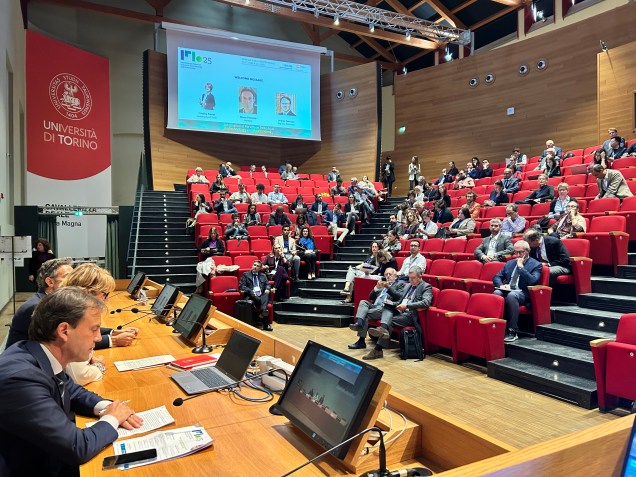
At IFIB 2025 in Turin, which was be held last Thursday and Friday, the world bioeconomy stakeholders called for action. “It’s a now or never!” This is, extremely briefly, the message that comes from the last edition of the International Forum on Industrial Biotechnology and Bioeconomy. In this invitation made at the opening of the forum by the executive director of the CBE JU, Nicolò Giacomuzzi-Moore, it can be synthesized the will of over 200 forum participants to move rapidly towards the creation of new markets for the bioeconomy and to accelerate the transition to a new, more sustainable economy, which finally could strengthen Europe’s competitiveness, growth and resilience.
“The strategies are not enough to govern the processes ,”hard law” is needed. Much of the sector’s underdevelopment can be traced back to the lack of adequate governance tools and the consequent mistake of analyzing these new industrial models through the lens of traditional value chains, with the paradoxes that erase from it, said Catia Bastioli, CEO Novamont.
It was a very well organized edition with the presence of many stakeholders from more than 20 different countries, included USA, Singapore, South Korea and Columbia.
Key note speakers were Erik Ripple, CEO NatureWorks, Agata Kotkowska, EU Commission DG Envi, Nicolò Giacomuzzi-Moore, executive director CBE JU, Catia Bastioli, CEO Novamont, Sofie Carsten Nielsen, director of the European Biosolutions Coalition and Gregory Jaffe, former USDA. They were also protagonist of a round table focused on policies together with Rick Fox (UC Berkeley) and Giulia Gregori (Novamont). Soon a IFIB 2025 Torino Statement will be released.
We are living in a time of accelerated change and unprecedented global challenges. However, the 21st century also offers unprecedented opportunities. The circular and sustainable bioeconomy is one of them, but unfortunately its development is threatened by a major obstacle: the privileged position enjoyed by the fossil-based economy, that benefits from different types of subsidies and generates environmental costs that are not absorbed by the markets in any way”.
Facing this operating framework, the development of the bioeconomy cannot be left to the markets and technology alone. Decoupling growth from environmental degradation requires a major shift towards a low-carbon, renewable and resource-efficient society that has a sustainable economy. Such a shift requires political leadership, vision and strategic action, said many speakers at IFIB.
Next year IFIB will be held in Rome on October 1-2.
 IL BIOECONOMISTA