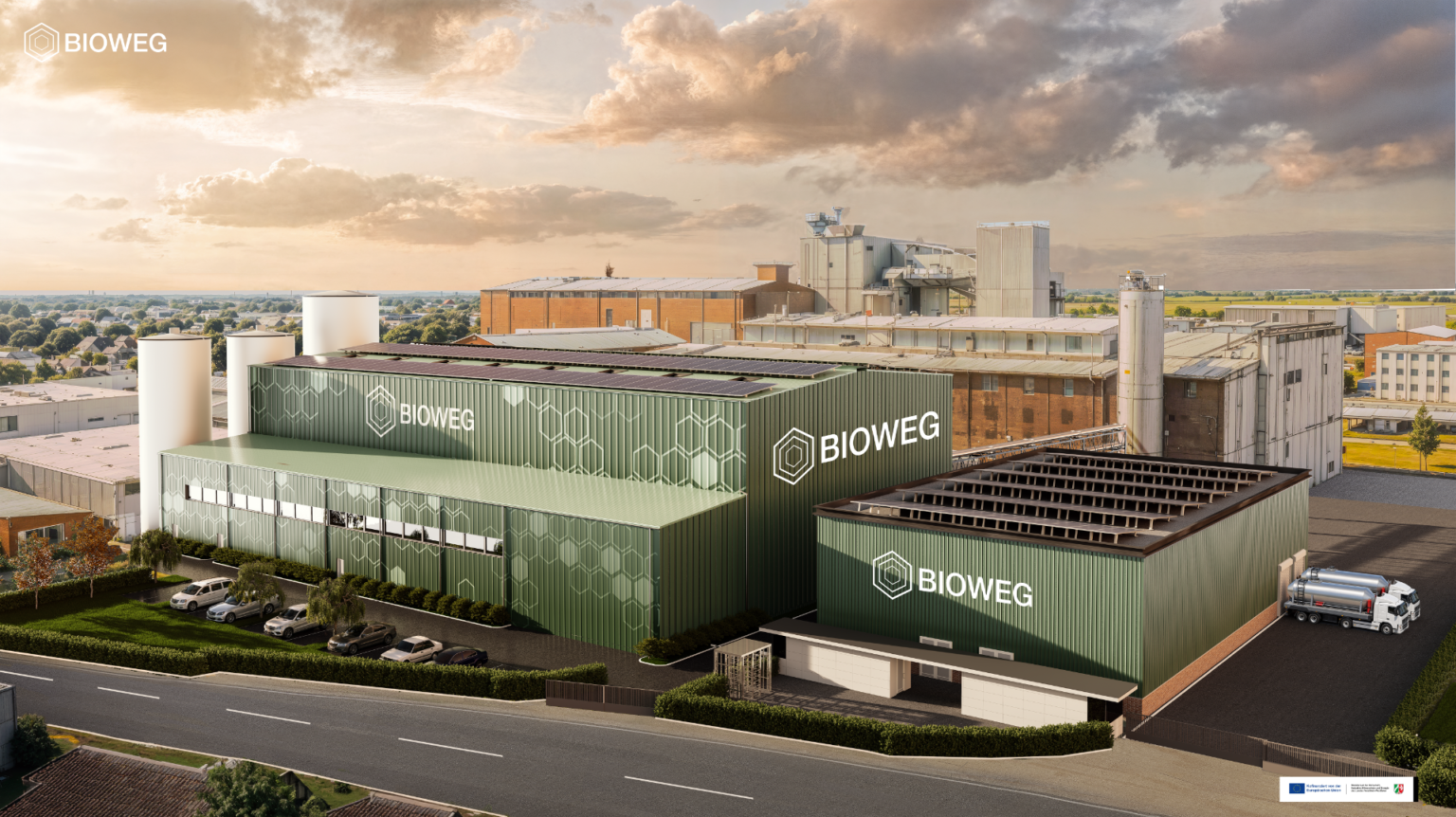
BIOWEG, the German deeptech company producing high-performance, biodegradable bacterial cellulose to replace fossil-based polymers and intentionally added microplastics, will begin construction of Europe’s largest bacterial cellulose production plant in Q4 2026. The first-of-a-kind facility, located in Elsdorf, North Rhine-Westphalia, will produce up to 10,000 tonnes a year, with first commercial volumes expected in 2028 — bringing onshore production of a material that Europe today almost entirely imports.
Europe’s restriction on intentionally added synthetic polymer microparticles, adopted under REACH in 2023, is removing fossil-based microplastics from fertiliser and seed coatings, cosmetics and detergents on a phased timetable running to the end of the decade. Formulators need replacements that match polymer performance and are available at industrial volume, in quantities they can rely on. Bacterial cellulose has the functional profile to do it; what has been missing is European capacity.
Elsdorf closes that gap, with construction starting before the end of this year and industrial-scale production ready from 2028. To accelerate development, BIOWEG has allocated around 60% of its total funding to the new site.
Since announcing its €16 million Series A led by Axeleo Capital in September 2025, BIOWEG has secured a further € 14 million: €2 million in equity from new investor Rabo Ventures, extending the Series A to € 18 million, € 10.3 million in non-dilutive funding provided by the EU as part of the “Produktives.NRW” grant competition under the EFRE/JTF Program for North Rhine-Westphalia 2021–2027, and 2 million from other sources, bringing total funding to € 35 million.
The plant’s economics start with its location. Built directly within one of Germany’s largest sugar industrial complexes, the facility will valorise molasses and other side streams as fermentation feedstock metres from where they are produced — cutting logistics emissions, lowering operating costs and securing supply. It is designed as a fully automated plant, drawing on the sugar industry’s decades of automation and robotics experience in operating profitably on thin margins, a model BIOWEG is applying to biomanufacturing. BIOWEG’s pilot site in Quakenbrück remains operational throughout construction: currently being upgraded and fully automated from around 100 to at least 200 tonnes a year, it will supply commercial sales batches through 2027 and 2028 until Elsdorf comes online and serves as the automation blueprint for the larger plant.
BIOWEG’s ingredients are already in commercial use, and Elsdorf is being built to meet increasing demand for them. In agriculture, the company’s microplastics-free fertiliser coatings, seed coatings and extrusion aids deliver the required functionality at up to 70% lower dosage than conventional synthetic alternatives in some formulations, lowering cost-in-use under industrial conditions. In cosmetics, personal care and home care, its bacterial cellulose-based ingredients provide texture enhancement, rheology control, suspending properties, film-forming and sensory effects from a fully bio-based, biodegradable input. Both are supported by BIOWEG’s in-house formulation team, which develops each ingredient against the customer’s specific use case and carries reformulation work in-house — a differentiator the company weighs equally with scale.
The plant also anchors BIOWEG in a region rebuilding its industrial base. The Rheinische Revier is undergoing a long-term transformation from coal-based industry towards novel technologies, and Elsdorf offers established infrastructure and access to skilled workers from the Cologne, Düsseldorf, Aachen and Ruhrgebiet talent pools; around 30 high-tech jobs will be created at the site. BIOWEG has grown within the region’s innovation ecosystem, including Circular Valley, Gateway Factory and Chemstars, and its expansion aligns with the direction of European policy: the Commission’s bioeconomy strategy and the industrial biotechnology package expected this autumn both target domestic biomanufacturing capacity, shorter supply chains, and industrial value built on renewable feedstocks.
Prateek Mahalwar, Co-founder & CEO, BIOWEG said: “Financing a First-of-a-Kind plant is the hardest step in industrial biotechnology, and it is the step we are now taking, with the German government and the EU sharing the risk of building. Food and agricultural side streams will always be available locally in Europe, and Elsdorf is where we’ll turn them into high-performance, biodegradable ingredients at industrial scale. Our customers reformulate when the performance holds and the cost works, and this plant is built to deliver both at the volumes they need.”
Katrien Swerts, Executive Director, Rabo Ventures, said: “BIOWEG has reached the point where proven technology and commercial demand can translate into industrial-scale impact. Its ingredients offer manufacturers a high-performance, biodegradable alternative to fossil-based polymers and intentionally added microplastics, while the Elsdorf facility provides the capacity needed to serve customers at scale. This combination of market need, compelling economics and a clear path to industrialisation makes this the right moment for us to invest. The investment also reflects W&R’s Clean Energy strategy of selectively supporting technologies and infrastructure that accelerate the transition to a more sustainable and circular economy while delivering long-term value for clients and society.”
Mona Neubaur, Minister for Economic Affairs and Climate Action, North Rhine-Westphalia: “We are tackling a huge problem at its root: microplastics entering our rivers through every wastewater pipe. In the Rheinische Revier, we are demonstrating how bacteria can be turned into genuine alternatives – made in North Rhine-Westphalia for the whole of Europe. This is structural change that pays off: new jobs, new value creation, and less dependence on imports.”

