The bioeconomy is going global. But countries are not building the same bioeconomy. Across 30 national strategies, governments are looking to biological resources, biotechnology and biological production systems to support economic development, industrial transformation and sustainability. Yet behind the common term bioeconomy lie markedly different strategic choices.
For some countries, the starting point is biological resources. Forests, agriculture, fisheries, marine resources and biomass provide the foundation for new value chains, materials, chemicals, food products and energy.
For others, the centre of gravity is shifting towards biotechnology, synthetic biology and biomanufacturing. Here, scientific capabilities, innovation, scale-up infrastructure and manufacturing capacity can be as important as access to biomass.
A third perspective puts greater emphasis on the conditions under which the bioeconomy develops: biodiversity, ecosystem resilience, circularity, climate responsibility, governance, regional development and societal well-being.
These different pathways can be understood through three complementary perspectives: the Bioresource Vision, Biotechnology Vision and Bioecology & Social Vision.
But they should not be seen as competing definitions of the bioeconomy. A national strategy may strongly reflect one, two or all three. The more revealing question is how countries combine them — and what those combinations tell us about the future direction of the global bioeconomy.
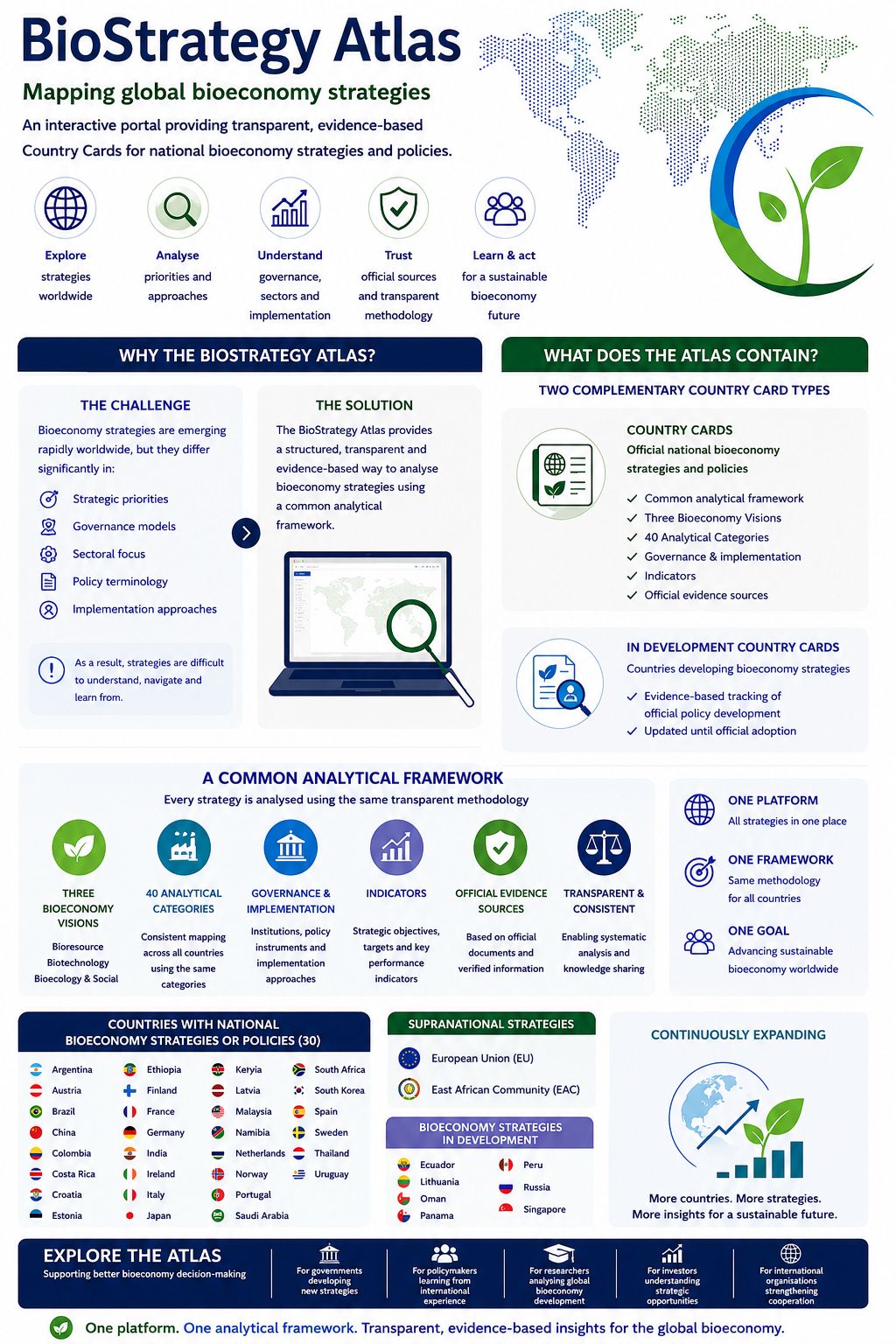
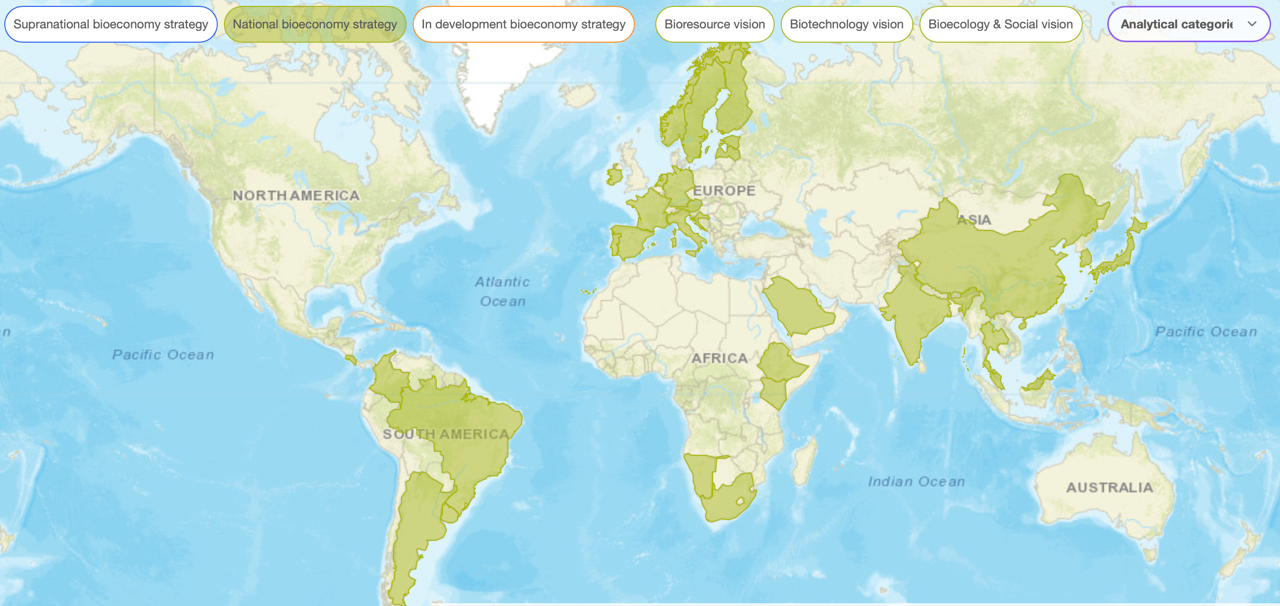
This is the question the BioStrategy Atlas sets out to explore. By analysing 30 national bioeconomy strategies through a common evidence-based framework, it makes different strategic choices and priorities visible and comparable. This can help policymakers learn from international approaches, while giving businesses, investors and researchers a clearer view of how the global bioeconomy is evolving.
Rather than ranking countries, the Atlas examines the strategies themselves: what governments identify as priorities, how they frame bioeconomy development and where they intend to focus action.
Each strategy is analysed through the same three visions and a taxonomy of 40 Analytical Categories, spanning biological resources, technologies and industrial applications, environmental priorities, governance and societal dimensions, as well as enabling conditions such as skills, digitalisation, markets and finance.
This distinction matters. A country may have a major forest industry without forestry being a central priority in the strategy being analysed. Likewise, it may have significant biotechnology capabilities without biotechnology occupying a central place in its bioeconomy strategy.
The Atlas therefore maps strategic intent — not national performance. And what emerges is not one global blueprint for the bioeconomy, but multiple pathways.
Across the 30 strategies, no single vision tells the whole story. Most combine elements of more than one vision, but the balance differs significantly between countries. Some place biological resources and value creation at the centre, others give greater weight to biotechnology and biomanufacturing, while others more strongly integrate biodiversity, circularity and societal priorities.
Resource-rich economies may seek to create greater value from forests, agriculture, marine resources and other forms of biomass. Technology-intensive economies may build around biotechnology and biomanufacturing. Others may place biodiversity, ecological resilience or inclusive regional development closer to the centre of their strategies.
None of these pathways is automatically more advanced than another. They reflect different resource bases, technological capabilities, ecological conditions and societal priorities.
The more important question may therefore be what happens when these pathways begin to converge.
Biological resources provide the renewable material foundation. Biotechnology creates new possibilities for transforming biological systems and resources into higher-value products and services. Ecological and societal considerations help determine whether that transformation can remain sustainable and legitimate over the long term.
The next chapter of the global bioeconomy may not be defined by which of these three visions dominates — but by how successfully they can be connected.
The BioStrategy Atlas launches in September 2026, providing a common analytical framework for exploring an evolving global landscape of national and supranational bioeconomy strategies — including strategies currently under development.