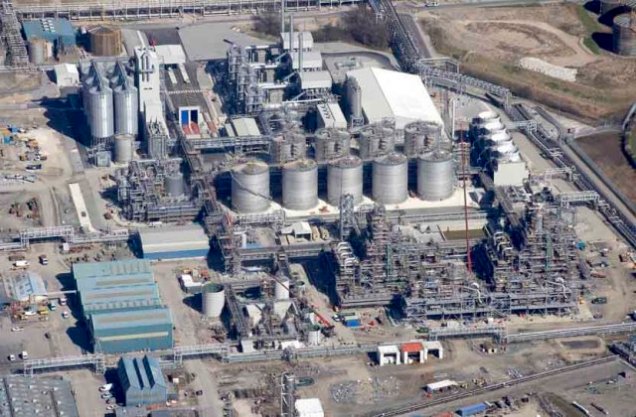
UK Business Secretary Greg Clark published last Monday the UK government’s modern Industrial Strategy, with a plan to boost productivity and the earning power of people and businesses throughout Northern Ireland and the whole of the UK. But Vivergo Fuels, the UK’s largest producer of bioethanol doesn’t like this strategy.
Mossi Ghisolfi is for sale. According to different rumors in Italy, Versalis, the chemical division of the oil giant Eni, and various European (such as the French oil colossus Total) and Asian industrial groups would be interested in acquiring the Italian chemical company which is one of the world’s largest PET manufacturer with a capacity of nearly 1.6 million tonnes per year and plants in Brazil, Mexico and the United States.
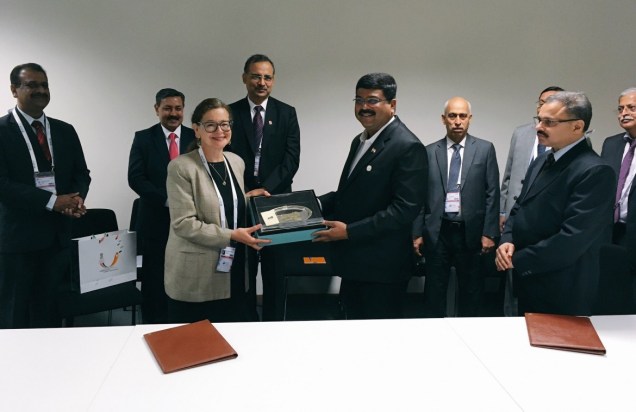
Jennifer Holmgren last July in Istanbul signed a Statement of Intent with IndianOil to construct the world’s first refinery off gas-to-bioethanol production facility in India. Source: LanzaTech
“Imagine wearing yoga pants made from recycled carbon!” said LanzaTech Ceo, Jennifer Holmgren. “We want people to have a choice of where their carbon comes from. Fresh fossil or recycled, ‘carbon smart’, products. Much like the idea of buying organic, fair trade or recycled products, we see a future where you can walk into a store and make a conscious decision to buy everything from a chair to running shoes made from recycled carbon. This future is now possible through advancements in synthetic biology which enable the production of targeted molecules.”
Christophe Schilling, CEO of Genomatica during his speech at the Grand Opening of Mater Biotech’s plant in Bottrighe di Adria, Italy
Genomatica published the results of a major survey of sustainability issues in the mainstream chemical industry. The survey was conducted together with ICIS, the world’s largest petrochemical market information provider. The survey, fourth in a series they have conducted since 2009, revealed substantial advances for sustainability and renewable chemicals in general, for chemical producers, users (companies making products from basic and intermediate chemicals) and distributors.
“There would be a mainstreaming of the development of the bioeconomy over the next year, and its embedding in other policies. Bioeconomy can reach parts of society and economy that other policies can’t reach”. To say this was John Bell, Director for Bioeconomy at DG Research and Innovation, at the ThinkForest seminar which took place in Brussels last 7 November.
Jean-Claude Juncker, President of the European Commission
Yesterday in Brussels was the Bioeconomy Policy day, a day dedicated not only to announce the outcomes of the review on the bioeconomy strategy presented in a Staff Working Document, but also to discuss how to move the bioeconomy forward. The EU Bioeconomy Stakeholders Panel launched the European Bioeconomy Manifesto to set out how the continent plans to grow this mult-trillion euro industry.
“Growing the Irish Forest Bioeconomy”. This is the title of a report launched by the minister of State at the Department of Agriculture, Food and the Marine, Andrew Doyle T.D. The report, produced by the Council for Forest Research and Development (COFORD), on the contribution and potential of the forest sector in the emerging Irish Bioeconomy has been submitted to the Department of An Taoiseach (taoiseach means leader and is the prime minister of Ireland). This is part of the on-going process to develop a Government Policy Statement on the Irish Bioeconomy.
Titan Hemp, a leading provider of hemp commodities and extracts based in Seattle (USA), has formed a joint venture with Green Growers Technology Alliance (GGTA) to create a new company, Titan BioPlastics, a manufacturing and development entity focused on creating plant-based composites and products for a wide variety of manufacturing applications, including packaging, nanotechnology, bio-polymers, construction, and bioplastics.
There is a new Brazilian-Danish partnership in the world bioeconomy. Braskem, the Americas’ leading producer of thermoplastic resins, and Danish-based Haldor Topsoe, a world leader in catalysts and surface science, have signed a technological cooperation agreement to develop a pioneering route to produce monoethylene glycol (MEG) from sugar. The agreement calls for the construction of a demonstration plant in Denmark, with operation slated to begin in 2019.
The output of China’s biological industry is expected to reach 10 trillion yuan (1.5 trillion U.S. dollars) in 2022. The compound annual growth rate of the bio-industry in China has been over 15 percent since 2011, according to a white paper on the industry jointly released by Tianjin Institute of Industrial Biotechnology and Chengdu Library and Information Center, both affiliated with Chinese Academy of Sciences.


 “Growing the Irish Forest Bioeconomy”. This is the title of
  Titan Hemp, a leading provider of hemp commodities and extracts based in Seattle (USA), has formed a joint venture with Green Growers Technology Alliance (GGTA) to create a new company, Titan BioPlastics, a manufacturing and development entity focused on creating plant-based composites and products for a wide variety of manufacturing applications, including packaging, nanotechnology, bio-polymers, construction, and bioplastics.
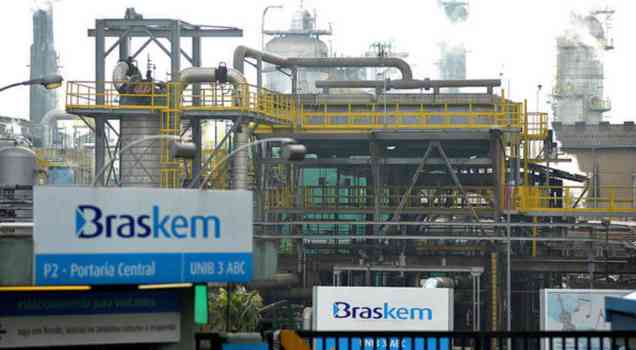 There is a new Brazilian-Danish partnership in the world bioeconomy. Braskem, the Americas’ leading producer of thermoplastic resins, and Danish-based Haldor Topsoe, a world leader in catalysts and surface science, have signed a technological cooperation agreement to develop a pioneering route to produce monoethylene glycol (MEG) from sugar. The agreement calls for the construction of a demonstration plant in Denmark, with operation slated to begin in 2019.
 IL BIOECONOMISTA