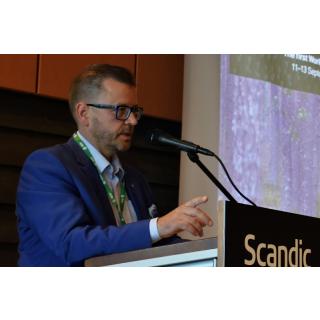
Marc Delcourt, co-founder and CEO of Global Bioenergies
Global Bioenergies aims at producing Sustainable Aviation Fuel (SAF) through its bio-isobutene technology, and has worked these last years on the ASTM international certification procedure. The balloting process, a key step for such certification, is now scheduled.
Eni Sustainable Mobility and PBF Energy Inc. entered into definitive agreements to partner in a 50-50 joint venture, St. Bernard Renewables LLC (SBR), for the biorefinery currently under construction co-located with PBF’s Chalmette Refinery in Louisiana (US). Upon consummation of the transaction, which is subject to customary closing conditions, including regulatory approvals, Eni Sustainable Mobility will contribute capital totaling $835 million plus up to additional $50 million that is subject to the achievement of eventual project milestones and will provide expertise in biorefining operations, supply and marketing. PBF brings its strong industrial know-how in the United States and, as the contributor of the biorefinery, will continue to manage project execution and serve as the operator once construction is complete.
The World BioEconomy Forum and partners launched a survey on the formation of a global hub to serve the bioeconomy sector. The aim of the hub is to encourage dialogue relating to all important matters concerning the global bioeconomy as well as its challenges and opportunities. The survey will allow stakeholders across the globe to advise and inform as to what the topics and subjects the hub should be comprised of. The bioeconomy is set to become a major economic stream in the future, and therefore will require growing international collaboration between the various parties.
Neste and Scania are piloting a digital solution that enables easy follow-up and verification of each truck’s usage of renewable fuels. Combining data from Scania Fleet Management Portal enriched with Neste’s fuel emission data, the solution provides Scania’s fleet management customers with accurate, up-to-date data for their greenhouse gas emissions (GHG) reporting and sustainability communications, both companies claim. Customers can compare the climate impact of their use of Neste’s renewable fuels to fossil fuels and track their continuous progress towards climate targets.
Twenty million jobs could be created worldwide through the power of nature, which could potentially address significant societal and environmental issues such as climate change, disaster risk, and food and water insecurity, as announced during the United Nation’s Biodiversity Conference, COP15, in Montreal.
The application period for Metsä Group’s funding programme for nature restoration projects started yesterday. Funding for planned and targeted measures aiming at safeguarding biodiversity can be applied for until 30 April. Metsä Group’s nature programme is a ten-year funding scheme, launched in 2021, which finances development projects promoting biodiversity implemented outside commercial Finnish forests. To date, 16 different projects across Finland have been granted funding, amounting to €600,000. The company does not seek business profit through the projects.
Koskisen is using Stora Enso’s bio-based binder, NeoLigno® by Stora Enso, to replace fossil-based resins used in furniture boards. Both the furniture board raw material and the binder are made of wood and sourced from the production process flows of both companies. This results in all raw materials of the Zero Furniture Board being bio-based. Koskisen is a Finnish wood industry company producing sawn timber and panel products, such as birch plywood, furniture, and construction boards made of chip board.
CJ Biomaterials, Inc., a division of South Korea-based CJ CheilJedang and leading producer of polyhydroxyalkanoate (PHA), and NatureWorks, an advanced materials company that is the world’s leading producer of polylactic acid (PLA), are collaborating on the development of sustainable materials solutions based on CJ Biomaterials’ PHACT™ Biodegradable Polymers and NatureWorks’ Ingeo™ biopolymers. The two companies will develop high-performance biopolymer solutions that will replace fossil-fuel based plastics in applications ranging from compostable food packaging and food serviceware to personal care, films, and other end products.
German environment minister Steffi Lemke said on Tuesday she would soon send proposals to the cabinet for the country to withdraw from the use of crop-based biofuels to achieve reductions in greenhouse gases, International Press Agency Reuters states. “Biofuels stand for land consumption and loss of biological diversity,” Lemke said in a speech on Tuesday posted on the environment ministry’s website. “To replace only around 4% of fossil fuel use in German road transport, a land space in Germany and abroad is needed which represents about 20% of the German agricultural area. That is not future-orientated.”
Finnish companies Metsä Group and VR are intensifying their cooperation on sustainability in logistics and have agreed a new joint target to halve emissions from transport covered by their cooperation by 2030. In addition, Metsä Group aims to transfer some of its current road transports to railways. For Metsä Group, the measures would represent a total emission reduction of around 14,000 tCO2e per year, which is equivalent to more than 25,000 average lorry journeys.






 IL BIOECONOMISTA