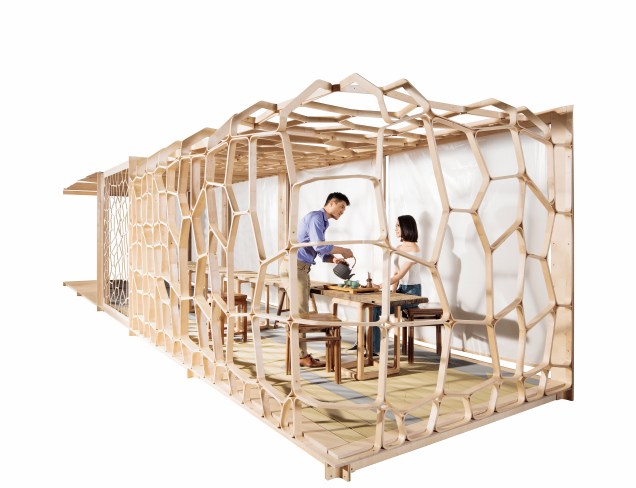
UPM, the Finnish forest industry company, and the Shanghai-based Tongji University College of Design and Innovation started cooperation in 2015 with a target to create a modern concept for the traditional Chinese tea house by using UPM’s innovative wood-based biomaterials. The project has now reached its goal with the introduction of the Biofore Tea House in the ‘Moi Helsinki’ event in Beijing, China on 13-15 May 2016.
Aemetis and Edeniq, both headquartered in California (USA), announced they have entered into a definitive agreement under which Aemetis will acquire all of Edeniq’s outstanding shares in a stock plus cash merger transaction.
Edeniq, a leading cellulosic ethanol technology company, has developed patented innovations that unlock cellulosic and starch sugars through a combination of mechanical and biological processes. Its capital light and operationally efficient solutions can be easily integrated into existing corn ethanol plants. The company, founded in 2008, has raised approximately $100 million from some of the world’s leading venture capital firms, including Kleiner Perkins Caulfield & Byers, Draper Fisher Jurvetson, Angeleno Group, The Westly Group, I2BF Global Ventures, and other leading investors, as well as US Department of Energy (DOE) grant funding.
Renewable materials company Stora Enso and specialty chemicals company Rennovia have announced a joint development and license agreement to cooperate on bio-based chemicals development.
“We believe that we are at the beginning of an evolution in the chemical industry where man has the ability to replace some chemicals that have been produced via the petro route with the same chemicals now using sugar as their source of carbon instead of fossil fuels”. Mike Hartmann, executive vice president of BioAmber, talks to Il Bioeconomista
BioAmber is a sustainable chemicals company, whose proprietary technology platform combines industrial biotechnology and chemical catalysis to convert renewable feedstock into building block chemicals for use in a wide variety of everyday products including plastics, resins, food additives and personal care products. The company, which is one of the main world bioeconomy’s players, has been listed on the New York Stock Exchange since May 2013, under the symbol BIOA. And is also listed on the NYSE Euronext Paris exchange, under the same symbol. BioAmber is a Delaware corporation with a head office in Montreal, Quebec, Canada, a research facility in Plymouth (Minneapolis), Minnesota, and a commercial plant operating in Sarnia, Ontario, Canada. Its investors include Sofinnova Partners (France), Naxos Capital Partners (Luxemburg), Mitsui & Co. (Japan), Lanxess (Germany) and the Cliffton Group (Canada).
The bioeconomy in the Netherlands takes another step forward, bringing together industry and agriculture. AkzoNobel, Dutch leading global paints and coatings company and a major producer of specialty chemicals, and agro-industrial cooperative Royal Cosun have formed a new partnership to develop novel products from cellulose side streams resulting from sugar beet processing.
Edilon)(sedra, Dutch international supplier of rail track systems, insulating rail systems and noise and vibration reduction systems, in cooperation with Wageningen UR and British speciality chemicals company Croda, is working on the development of next generation polymers for elastic rail fastening systems. The goal of the project is to develop environmentally-friendly bio-based polymers which cure into an elastic rubber-like compound within a limited time.
Bioeconomy, agro-food, start-ups and Expo Milan 2015. These are the issues that Il Bioeconomista faces in this interview with Gianluca Carenzo, director general of the Science Park of Lodi and president of Apsti, the Association of Italian Science Parks.
Valmet – an Australian leading global developer and supplier of technologies, automation and services for the pulp, paper and energy industries – and Biochemtex, which is part of Italian Mossi Ghisolfi Group, will start to cooperate in the field of conversion of lignin into biochemicals. To announce this are both companies in a note. The development project will combine and adapt LignoBoost and Moghi technologies. LignoBoost is Valmet’s proprietary technology for the extraction of purified lignin from black liquor produced by pulp mills.
Lee Edwards, president and CEO of Virent Energy Systems (Photo Andy Manis). Source: Virent
Bioproducts are everywhere. And now we have also bio-based shirts. Virent, the bioeconomy company headquartered in Madison, Wisconsin, announced that its BioFormPX® paraxylene was used to produce the world’s first 100% plant-based polyester shirts. “This important project- the company says – demonstrates the potential of Virent’s technology to produce demonstration quantities of bio-based, crude oil free polyester for production of garments and textiles”.
Avantherm, a Swedish company specializing in Heat Transfer Media products, has started using Neste Renewable Isoalkane to produce the next generation, high-performance and more environmentally friendly products that will facilitate the transition to a fossil free society. Avantherm becomes one of the first companies in the world to market Heat Transfer Media produced from renewable raw materials.






 IL BIOECONOMISTA