The production processes of the most important basic chemicals are responsible for around 70 percent of the greenhouse gas emissions in the chemical industry. “BASF experts – the German chemical giant claims – are working intensely on new technologies to substantially reduce emissions in these processes. The company has bundled all of this work under the roof of its ambitious Carbon Management Program”.
Marc Palahi, Director of EFI, at the European Bioeconomy Summit in Helsinki
The European Forest Institute (EFI) and the Center for International Forestry Research (CIFOR) plan to join forces on research including the role of sustainable forest management in achieving the U.N. Sustainable Development Goals and to better connect science to policy action.
The two organizations on May 24 signed a Memorandum of Understanding in Barcelona, establishing a partnership to advance and communicate forest science and support sustainable development. The agreement will help put forests front and center on the global development agenda, according to Marc Palahí, Director of EFI, and Robert Nasi, Director General of CIFOR.
King of Prussia-based Renmatix is introducing Celltice™, the beauty industry’s first zero-chemical self-emulsifying active. A brand-new ingredient consisting of botanical building blocks cellulose and lignin, Celltice delivers a variety of benefits in personal care and cosmetic applications, functioning both as an active and an excipient in formulations.
The first-ever commercial flight to produce no landfill waste took to the skies last Wednesday, marking the start of Qantas’ plan to cut 100 million single-use plastics by end-2020 and eliminate 75 per cent of the airline’s waste by end-2021. All inflight products on board QF739, flying from Sydney to Adelaide and staffed by cabin crew from the Qantas ‘Green Team’, will be disposed of via compost, reuse or recycling.
The viability of Anellotech’s Bio-TCat™ technology has now been proven by achieving commercially-targeted yields in its TCat-8® pilot unit in Silsbee, Texas during six months of continuous process operations.
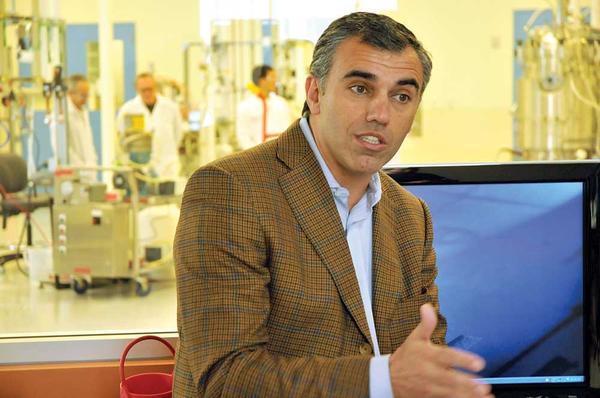
Christophe Schilling founded Genomatica in 1998. Since being named CEO in May 2009, he has led Genomatica to widespread recognition as a leader in industrial biotech, with a commercialized first process and plant and multiple leading partners. The company has earned awards for industry impact (recognized in ICIS Top40 Power Players five years in a row), engineering (Kirkpatrick), science (EPA Presidential Green Chemistry), industry leadership (voted #1 Hottest four years in a row by Biofuels Digest), and company culture (The Scientist as a Best Place to Work). Christophe is Chairman of Biocom, the largest advocate organization for California’s life sciences sector; serves on BIO’s Industrial & Environmental Section Governing Board; serves on the World Economic Forum Global Agenda Council on Biotechnology; and is a member of YPO, an international leadership organization for chief executives. In this exclusive interview with Il Bioeconomista, he talks about the recent agreement with Covestro and the Genomatica’s way towards the bioeconomy.
Metsä Board and its associated company Metsä Fibre, both part of Metsä Group, will launch pre-engineering phases for three major investments. All three investments will further develop the competitiveness of pulp and energy production for both companies, and move them towards fossil-free production.
UPM Plywood is joining forces with Studio Bark and Fologram to create a unique building experience for self-builders at the Grand Designs Live event. Two UPM WISA Plywood products will be centre stage at the Grand Designs Live show in London May 4-12 on an unusual stand created by pioneering environmental architects Studio Bark.
Amyris, a leader in the development and production of sustainable ingredients for the Health & Wellness, Clean Beauty and Flavors & Fragrances markets, sold its Vitamin E royalty agreement to Koninklijke DSM N.V. (Royal DSM). This agreement assigns Amyris’s rights to Vitamin E royalties to DSM in exchange for total consideration of approximately $57 million. In addition, DSM and Amyris have agreed to a further manufacturing cooperation for Amyris products at DSM’s Brotas facility that provides additional capacity and lower cost of goods sold with an expected approximate aggregate benefit of $30–$40 million over the next three years. The expected economic benefit of both agreements to Amyris is approximately $90 million.
Nouryon has taken a step forward in the bioeconomy. The Dutch company (formerly AkzoNobel Specialty Chemicals) has expanded its offering for the asphalt market with Wetfix G400, a versatile non-amine adhesion promoter derived from renewable resources. Wetfix G400 meets customers’ needs for a more sustainable alternative that maintains asphalt mixture performance and durability.


 The first-ever commercial flight to produce no landfill waste took to the skies last Wednesday, marking the start of Qantas’ plan to cut 100 million single-use plastics by end-2020 and eliminate 75 per cent of the airline’s waste by end-2021. All inflight products on board QF739, flying from Sydney to Adelaide and staffed by cabin crew from the Qantas ‘Green Team’, will be disposed of via compost, reuse or recycling.


 Nouryon has taken a step forward in the bioeconomy. The Dutch company (formerly AkzoNobel Specialty Chemicals) has expanded its offering for the asphalt market with Wetfix G400, a versatile non-amine adhesion promoter derived from renewable resources. Wetfix G400 meets customers’ needs for a more sustainable alternative that maintains asphalt mixture performance and durability.
 IL BIOECONOMISTA