On the sidelines of COP30, government representatives and industry leaders yesterday launched the Biofuture Platform Declaration on Sustainable Chemicals and Materials, a landmark international statement to accelerate the transition from fossil carbon to sustainable carbon feedstocks in the global chemical industry.
Computer-generated aerial view of the North Blyth biomass power station
The European Bioeconomy Alliance (EUBA) released a new expert paper by the nova-Institute, titled “Benefits of Using First-Generation Biomass for Food, Fuels, Chemicals and Derived Materials in Europe: Science-based Argumentation Paper.” According to EUBA, the research confirms that using first-generation agricultural biomass – such as cereals, sugar, and oilseed crops – to produce bio-based energy and materials delivers significant benefits for food security, biodiversity, agriculture and climate change mitigation across Europe.
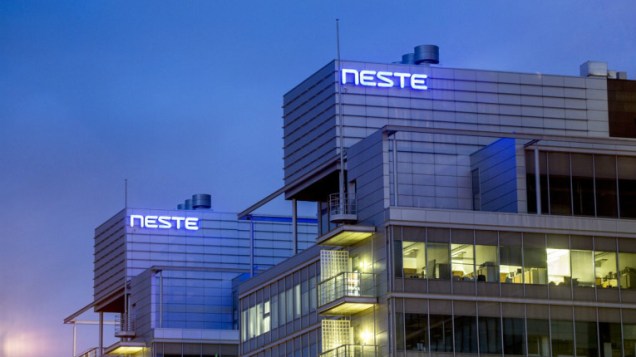
Neste and United Airlines have expanded their existing partnership to supply sustainable aviation fuel (SAF) to three new major airports in the United States. The new agreement makes United the first commercial airline to purchase SAF for use on flights from George Bush Intercontinental Airport (IAH) in Houston, Newark Liberty International Airport (EWR) in New Jersey, and Dulles International Airport (IAD) in Washington D.C.
Eni and the Bioenergy Association for Sustainable Development, affiliated with the Ministry of Environment of the Arab Republic of Egypt, signed in Cairo a cooperation agreement to prepare a comprehensive feasibility study for establishing biogas production units based on the treatment of animal and agricultural waste. The signing ceremony took place in the presence of Eng. Karim Badawi, Minister of Petroleum and Mineral Resources, and Dr. Manal Awad, Minister of Local Development and Acting Minister of Environment.
Berlaymont, European Commission’s Headquarter in Brussels
The European Commission launched two public consultations on the future Biotech Act and Circular Economy Act, which are expected to be adopted in 2026. The aim is to gather input from citizens, organizations, and interested groups, promoting a participatory process in defining these strategic initiatives for the European Union.
Former EU Commissioner Máire Geoghegan-Quinn speaks to delegates during the Bioeconomy conference in Dublin on February 14, 2013.
The Department of Agriculture, Food, and the Marine, the Department of Climate, Energy, and the Environment and the International Advisory Council of the Global Bioeconomy (IACGB) today announced that the fifth Global Bioeconomy Summit (GBS 2026) will take place in Dublin, Ireland on 20 and 21 October 2026 at the Convention Centre Dublin, during Ireland’s presidency of the Council of the European Union.
Within the framework of the World Food Forum, the Food and Agriculture Organization of the United Nations (FAO) and the Amazon Cooperation Treaty Organization (ACTO) reaffirmed their commitment to sustainable development by presenting the Amazon Bioeconomy Investment Program to representatives of the private sector, multilateral banks, governments, and institutions committed to transforming agrifood systems.
The partnership project between Stora Enso, the International Union for Conservation of Nature (IUCN) and Newcastle University that was initiated in early 2024 to advance positive impacts on forest biodiversity has been completed. The aim of this collaboration was to create a framework for the forestry sector to reach a net positive biodiversity impact with active forest management by reducing threats to species and conserving and restoring ecosystems.
Avantium, a Dutch leader in renewable and circular polymer materials, signed Memoranda of Understanding with Tereos, a global leader in sugar, starch, alcohol and bioethanol production, and with LVMH GAÏA, the scientific and environmental R&D division of LVMH Moet Hennessy – Louis Vuitton, the world leader in luxury. Together, the parties will establish a strategic collaboration to accelerate the industrial-scale production of PEF (polyethylene furanoate), Avantium’s 100% renewable and circular performance polymer known under the brand name releaf®. Releaf® is made from plant-based feedstocks and can be applied across food & beverage packaging, cosmetic packaging, fashion and industrial fibers. This alliance unites Avantium as the inventor of releaf® with trailblazers Tereos and LVMH to scale bio-based plastics from plant-based resources, contributing to the transition away from fossil-based plastics.
All the EU bioeconomy stakeholders will gather in Copenhagen in December. As Denmark assumes the Presidency of the Council of the European Union in the second half of 2025, the University of Copenhagen and the Danish Ministry for Green Transition, on behalf of the European Commission, will host two conferences focused on advancing the EU’s green transition through bioeconomy, food systems, and biodiversity. The conferences will take place on the 2 and 3 December 2025.