Another brick towards the European Bioeconomy. The European Commission organises from 12 to 13 April in Utrecht, The Netherlands, the EU Bioeconomy Stakeholders’ Conference. Four years on from the launching of the EU’s Bioeconomy Strategy, Brussels in collaboration with the Dutch Presidency analyses the achievements and the opportunities ahead in the two-day conference.
Italian biotech company Bio-on announces the launch of a new collaboration with Italeri S.p.A., a production and distribution leader in the modelling sector. Thanks to this agreement, the manufacture of scale models will be done for the first time with the special grade Minerv PHA Supertoys, the new type of bioplastic developed by Bio-on laboratories.
Raffaele Liberali in Metaponto (Basilicata, Italy)
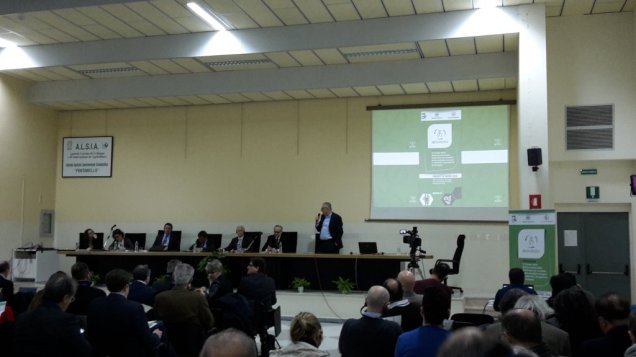
Italy will have its own strategy on bioeconomy by next summer. This was announced by Mario Calderini, representative of the Ministry of Education, University and Research, yesterday in Metaponto, Basilicata, during the launch event of the regional bioeconomy cluster. Good news, then, for the bioeconomy in Italy, where it seems that the issue is increasingly on the agenda of the institutions.
“They are on a journey of no return anyway. They are a “mining” industry, and all mines eventually become exhausted. The question is whether some or all of the petrochemical industry will realize this fact and act to change their feedstocks and practices so that their businesses can continue long term based on sustainable feedstocks and sustainable practices.” To say it – in this exclusive interview with Il Bioeconomista – is Bruce E. Dale, a highly-ranked academic in the Top 100 People in Bioenergy (Bioenergy Digest). Professor Dale received his doctorate in chemical engineering from Purdue University in 1979. He is currently University Distinguished Professor of Chemical Engineering at Michigan State University. He serves as Editor in Chief and Founding Editor of Biofuels, Bioproducts and Biorefining. Dale has won the Charles D. Scott Award (1996), the Sterling Hendricks Award (2007) and the Award of Excellence of the Fuel Ethanol Workshop (2011). He is a Fellow of the American Institute of Chemical Engineers (2011) and a Fellow of the American Institute of Medical and Biological Engineers (2016).
His research interests are cellulosic biofuels, the relationship between energy and societal wealth, life cycle assessment and the design of sustainable systems for producing fuels, chemicals, food and animal feed.
The German chemical giant BASF and the Dutch leading chemical technology company Avantium today announced that they have signed a letter of intent and entered into exclusive negotiations to establish a joint venture (JV) for the production and marketing of furandicarboxylic acid (FDCA) produced from renewable resources, as well as marketing of polyethylenefuranoate (PEF), based on this new chemical building block.
For International Women’s Day, we dedicate a tribute to the 8 women who have distinguished themselves in the bioeconomy in 2015. With their huge capacity and their infinite passion, they are the stars of the world bioeconomy. Of course, best wishes to all women. Continue reading →
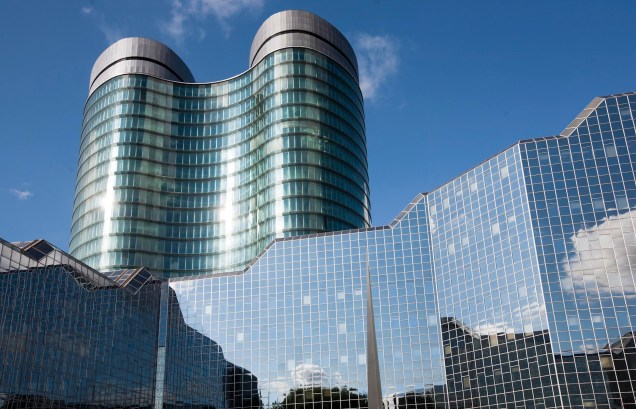
Berlaymont, European Commission's Headquarter in Brussels
The Bio-based Industries Consortium (BIC) announced at its general assembly the results of the first extensive macro-economic study on the European Bioeconomy. The study, performed by nova-Institut, shows a turnover of 2.1 trillion EUR and employment of 18.3 million jobs for the European Bioeconomy.
“Making The Revenant was about man’s relationship with the natural world,” Di Caprio said. “A world that we collectively felt in 2015 was the hottest year in recorded history. Our production team needed to go to the southern tip of this planet just to be able to find snow; climate change is real, and it’s happening right now. It is the most urgent threat facing our entire species and we need to work together and stop procrastinating. We need to support leaders around the world who do not speak for the big polluters or the big corporations, but who speak for all of humanity; and for the indigenous people of the world; for the billions and billions of underprivileged people who will be most affected by this; for our children’s children; and for all the people out there whose voices have been drowned out by the politics of greed. Let us not take this planet for granted; I do not take tonight for granted.”
Ilkka Hämälä, CEO of Metsä Fibre, a part of Metsä Group
Metsä Group, the Port of Helsinki and the City of Helsinki have reached an agreement on the use of the harbour and the lease of an area for a terminal building of around 30,000 square metres. The terminal will serve as an export warehouse for the bioproduct mill and will be completed before the mill is inaugurated in the third quarter of 2017.
Starting from last Friday, jet biofuel is offered to all airlines that refuel at Oslo Airport, making the airport the world’s first to offer this service through the normal supply mechanism. Air BP is the supplier of the jet biofuel and Lufthansa Group, SAS and KLM have already signed agreements to purchase the fuel.



 For International Women’s Day, we dedicate a tribute to the 8 women who have distinguished themselves in the bioeconomy in 2015. With their huge capacity and their infinite passion, they are the stars of the world bioeconomy. Of course, best wishes to all women.


 IL BIOECONOMISTA