Starting from last Friday, jet biofuel is offered to all airlines that refuel at Oslo Airport, making the airport the world’s first to offer this service through the normal supply mechanism. Air BP is the supplier of the jet biofuel and Lufthansa Group, SAS and KLM have already signed agreements to purchase the fuel.
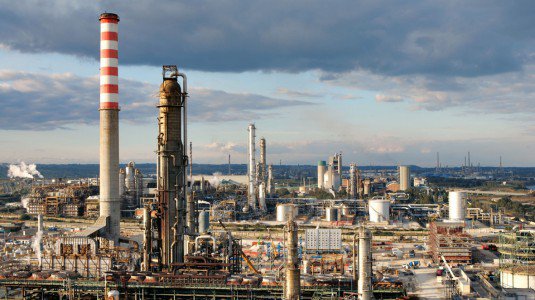
The Italian green chemistry will speak American. Eni confirms that it is in search for a partner for Versalis, its synthetic rubber and chemicals company. In a meeting at the Italian Ministry of Economic Development (Mise), between Mise, Eni, Versalis and representatives from the National Confederation of Industry and Trade Unions regarding the prospects for Eni’s petrochemical business, the Italian oil and gas company said it intended to retain a “significant stake” of Versalis in the partnership to “ensure its objectives are successfully met”.
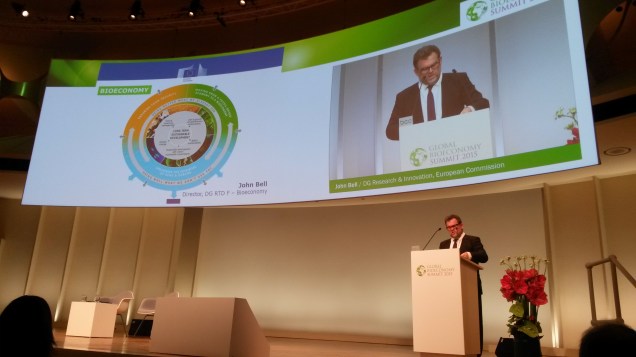
John Bell at Global Bioeconomy Summit in Berlin (25 November 2015)
“The shift to a European bioeconomy is now irreversible and this transition will now accelerate after the COP21”. John Bell, Director of Bioeconomy Directorate of the European Commission, talks to Il Bioeconomista. In this long exclusive interview, the man who is leading the implementation of the European bioeconomy addresses different topics related to this new industrial revolution based on renewable biological resources.
“The sustainability of the bio-based solutions – Bell says – will have to be constantly demonstrated, communicated and debated with stakeholders if we want to convince policy-makers and embed the bioeconomy across Europe. This can happen at different levels. The European Commission is devoting resources to better study the overall biomass available in Europe and its uses, and to assess the efficiency of the bio-based solutions through life-cycle analysis.”
The new awear bio-based glasses. Photo: courtesy of awear
Now we have bio-based glasses. Charmant USA has announced the launch of a new bio-based sustainable eyewear brand. The brand is awear: it is specialized in bio-made sustainable optical glasses and sunglasses.
The U.S. Department of Agriculture has released a list of its 2015 top achievements. According to the department, these achievements demonstrate efforts to help farmers and ranchers build the American bioeconomy.
thank you very much, heartily. 2015 ended with excellent results for Il Bioeconomista: over 46% more visits to our blog. It is a real boom, which shows how the bioeconomy is increasingly a phenomenon that attracts the attention of global public opinion and gratifies us as journalists, observers of a reality that we have always defined as the industrial revolution of the Third Millennium.
Bioeconomy every day @ BioBased World 2015 in Frankfurt am Main
The bioeconomy is innovation, the result of the skills and passion of researchers and managers able to create value and new high-qualified jobs. At the end of 2014 Il Bioeconomista launched a new initiative: The 10 Most Innovative Bioeconomy CEOs. We ask a panel of world bioeconomy experts to tell us the Chief Executive Officers that have stood out as the most innovative during the last year.
Caserta re-starts from the bioeconomy. If the Southern Italian city between the Eighteenth and Nineteenth centuries was known everywhere for the quality of its silk, today can aspire to become a center of gravity of the new sustainable bio-based economy. Here, GF Biochemicals launched last July the commercial-scale production of levulinic acid, using biomass as feedstock. The levulinic acid is a chemical building block that is used in various industrial sectors, from pharmaceuticals to cosmetics, from personal care to flavors and fragrances, from coating to fuel additives. In 2015 the company has produced 2 thousand tons and aims at producing 10 thousand tons in 2017 and up 50 thousand tons by 2019. A revolution, if we think that the company located in Caserta is certain to offer to the market in a few years the bio-based levulinic acid to a price of one dollar per kilo, versus the current 4-5 dollars per kilo for the corresponding product from oil, offering the same performance.
The protagonists of this bio-revolution, which is a key to economic development crucial for Italy and the Southern Italy in particular, are Pasquale Granata, young local entrepreneur, and Mathieu Flamini, the famous Arsenal player, former AC Milan, who unveiled a few days ago his involvement in the company in an interview with the Sun on Sunday.
In this exclusive interview is Pasquale Granata to talk with us about GFBiochemicals and the bioeconomy, as a key to regional regeneration to create economic development and new jobs within a framework of eco-sustainability.
“The bioeconomy can and should be the path for the re-industrialization of Brazil, fostering much needed innovations and development of products and processes that will fast-track the establishment of the this new norm in a global scale”. To say this – in this exclusive interview with Il Bioeconomista – is Bernardo Silva, Executive President at Brazilian Industrial Biotechnology Association (in Portuguese ABBI – Associação Brasileira de Biotecnologia Industrial), a trade association that brings together companies and institutions developing and using microorganisms and its derivatives to deliver renewable products for industries and consumers worldwide. The founding members of ABBI are Amyris, BASF, BioChemtex, BP, Centro de Tecnologia Canavieira, Dow, DSM, DuPont, GranBio, Novozymes, Raízen and Rhodia. With Silva we talk about Brazilian bioeconomy and the country’s national strategy to support the field. “The ambition to establish a vibrant bioeconomy in Brazil, which values our comparative advantages and is able to realize the opportunities arising from this new model of development, entails a joint effort between government, business and civil society to discuss, define and practice a plan that ensures the alignment of policies in place and long-term strategies, paving the way for Brazil fulfill its role as a leader a global bio-based economy.”
The bioeconomy is protagonist at COP21 in Paris. BioAmber, a leader in renewable materials, yesterday announced that it has joined the American Business Act on Climate Pledge, alongside more than 140 companies from across the American economy that are standing with the Obama Administration to demonstrate an ongoing commitment to climate action and to voice support for a strong outcome to the COP21 Paris climate negotiations.



 Dear Readers,

 “The bioeconomy can and should be the path for the re-industrialization of Brazil, fostering much needed innovations and development of products and processes that will fast-track the establishment of the this new norm in a global scale”. To say this – in this exclusive interview with Il Bioeconomista – is Bernardo Silva, Executive President at Brazilian Industrial Biotechnology Association (in Portuguese ABBI – Associação Brasileira de Biotecnologia Industrial), a trade association that brings together companies and institutions developing and using microorganisms and its derivatives to deliver renewable products for industries and consumers worldwide. The founding members of ABBI are Amyris, BASF, BioChemtex, BP, Centro de Tecnologia Canavieira, Dow, DSM, DuPont, GranBio, Novozymes, Raízen and Rhodia. With Silva we talk about Brazilian bioeconomy and the country’s national strategy to support the field. “The ambition to establish a vibrant bioeconomy in Brazil, which values our comparative advantages and is able to realize the opportunities arising from this new model of development, entails a joint effort between government, business and civil society to discuss, define and practice a plan that ensures the alignment of policies in place and long-term strategies, paving the way for Brazil fulfill its role as a leader a global bio-based economy.”

