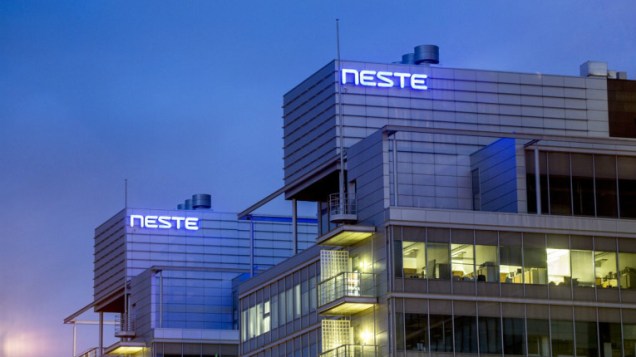
Neste and World Fuel Services (World Fuel) have extended their existing relationship with a five-year agreement that will expand the availability of Neste-supplied sustainable aviation fuel (SAF) at more than 100 airports across World Fuel’s UK and European network.
Odfjell has launched the first operational green corridor between Brazil and Europe. “Our chemical tankers are now sailing the 5,000-nautical-mile route between Brazil and Europe with substantially lower emissions. The corridor will operate 12-15 voyages per year, each lasting around 40 days”, states the Norwegian company.
”We have established an offtake of B24 sustainable biofuel blend in Rio Grande to secure long-term fuel availability. The Ports of Antwerp-Bruges, Rotterdam and Rio Grande are working together with our team to advance the green corridor through increased efficiency and optimized port-stay processes.”
“We do this to demonstrate that certified fuel, technology, and infrastructure are already available,” says CEO Harald Fotland. “Through this, we show that sustainable biofuel is a viable option for deep-sea shipping today.”
Fotland emphasizes that this is not a one-off demonstration but a long-term commitment.
“With this corridor, we integrate greener fuel as a new pillar in our decarbonization strategy. We activate the entire value chain to find ways to decarbonize our operations, and we are encouraged that key stakeholders are joining us in this groundbreaking initiative.”
Odfjell has taken independent action—self-funding the project and moving ahead without subsidies.
“By covering the additional cost ourselves, we eliminate the financial element and move directly into operational implementation. It may not be a perfect corridor yet, but a solid start. Its success depends on collaboration across the value chain, and we are committed to developing it further together with relevant stakeholders,” Fotland says.
This includes collaboration with ports to increase efficiency, with customers to maximize capacity utilization, and with fuel providers to increase the influx of green fuels.
In Brazil, the currently available sustainable biofuel quality is the so-called certified B24—a blend of 24% renewable biodiesel derived from waste and 76% VLSFO. Introducing biofuel marks another step in Odfjell’s decade-long work to reduce emissions. “We have already improved our carbon intensity by more than 54% compared to the 2008 benchmark, achieved through a wide range of technical and operational measures.”
“We hope to inspire broader industry action and welcome continued collaboration with regulators, ports, producers, other ship operators, and customers to accelerate the transition to low-emission maritime transport,” Fotland ends.
“We congratulate Odfjell on taking the lead and demonstrating what is possible when business and public authorities cooperate across national borders to reduce emissions. Green shipping corridors over long distances are still in their early stages, and this therefore represents an important first step on the path toward zero emissions. The ocean is the link in trade between Brazil and Norway. This new green shipping corridor is the result of Norway’s cooperation with Brazil on more climate-friendly shipping. We will continue this work with the aim that more vessels can gradually adopt a wider range of low- and zero-emission fuels.”
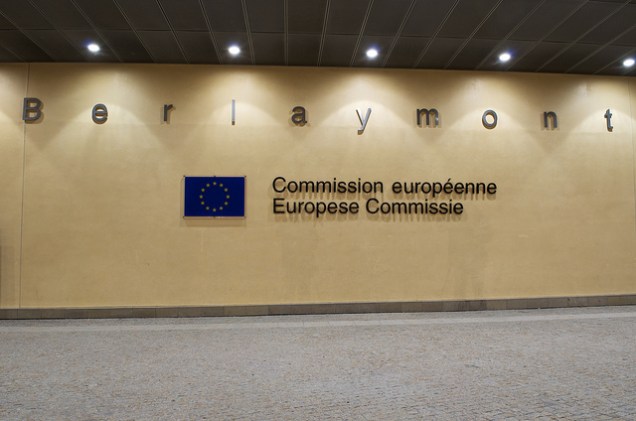
Berlaymont, European Commission’s Headquarter in Brussels
Today, the Commission adopted a new Strategic Framework for a Competitive and Sustainable EU Bioeconomy, charting a way forward to build a clean, competitive and resilient European economy. By using renewable biological resources from land and sea and providing alternatives to critical raw materials, the EU will move forward towards a more circular and decarbonised economy and can decrease dependence on fossil imports.
Thomas Philipon – CEO TotalEnergies Corbion – showcasing the Luminy PLA based noodle cups. Source: TotalEnergies Corbion
The ReBioCycle project kickoff took place at the University College Dublin on 2-3 October 2024. European Bioplastics and its members, including TotalEnergies Corbion, AIMPLAS, Novamont, Corbion, Sulapac, and Kaneka are amongst the 20 partners that have joined forces for developing and implementing “A new European blueprint for circular bioplastics upcycling solutions”, under the lead of the University College Dublin and BiOrbic Bioeconomy SFI Research Centre.
Another bad news for the European bio-based economy. Clariant, a sustainability-focused specialty chemical company, today announced its decision to shut down its sunliquid® bioethanol production in Podari, Romania, and to downsize related activities of the business line Biofuels & Derivatives in Germany (Straubing, Planegg and Munich).
“We need to grow the bio-based sector. Especially, if you look at the challenges the world is facing. That means, not just research and innovation, but actually scaling-up the production of our new bio-based products and processes in Europe. For that, we need more investment in new biorefineries in Europe.” Dirk Carrez, CEO of BIC (Biobased Industries Consortium), a non-profit organisation set up in Brussels in 2013 to represent the private sector in a Public-Private Partnership (PPP) with the European Commission, talks to Il Bioeconomista about present and future of the European bioeconomy.
Berlaymont, European Commission’s Headquarter in Brussels
For the first time, BIC has published a Trend Report on how Europe can unleash the full potential of the bioeconomy, enabling it to better contribute to the EU’s green transition. In 2012, the world admired Europe as a global frontrunner for launching its EU bioeconomy strategy. Today, the world and Europe look to other regions that are bolder in making the bioeconomy a strategic industry sector. In particular, the US with its recently-launched initiatives, but also China, India and the G20.
EFI Director Marc Palahí, Joensuu 21.6.2021. Photo: Johanna Kokkola
“One of the greatest advantages of the circular bioeconomy is the fact that it relies on renewable biological resources and renewable energy which we can develop, manage and process in Europe, which is not a continent rich in fossil resources or rare earth materials.” To say it – in this exclusive interview with Il Bioeconomista – is Marc Palahí, director of the European Forest Institute. He talks about circular bioeconomy, the role played by the forest-based sector, the Circular Bioeconomy Alliance founded by His Majesty King Charles III (formerly The Prince of Wales) and the next event focused on Biocities, which will take place in Rome on April 20.
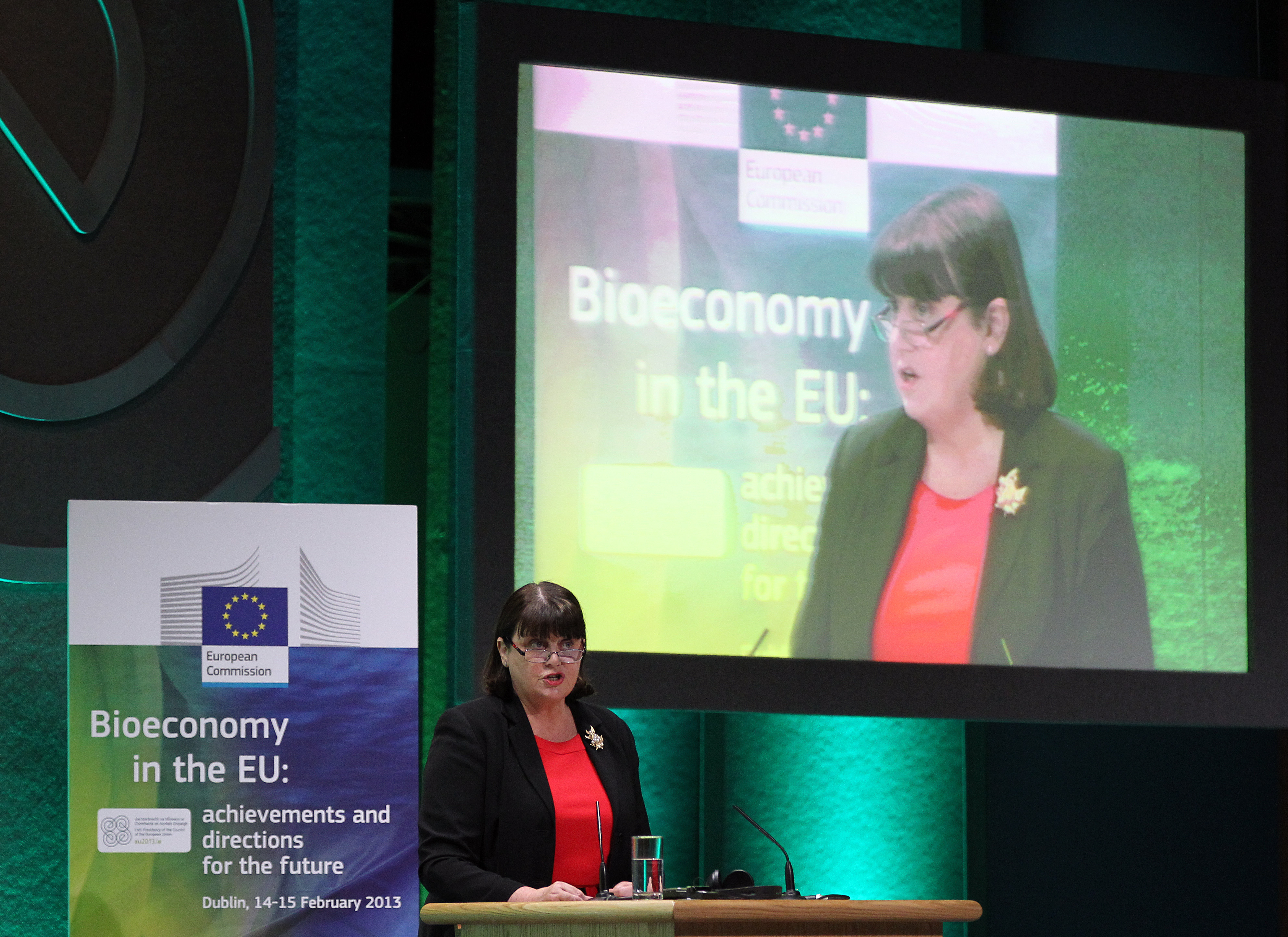
Former EU Commissioner Máire Geoghegan-Quinn speaks to delegates during the Bioeconomy conference in Dublin on February 14, 2013.
Contribute to the sustainability of society by designing a bio-based product or process. This was the task set for pioneering student teams participating in the third edition of the European Biobased Student Innovation Challenge 2021. The five finalists presented their innovative projects to a jury consisting of leading experts from across the bio-based sector. The combined votes from the expert jury and an audience of bio-based industry representatives decided which of the top five teams was the overall winner of BioSYNERGISE 2021, an event organised by the Bio-based Industries Consortium (BIC). Team WaterSkins from the Netherlands rose to the top with their innovative idea to harness wastewater to produce a leather-like material.
“I am convinced that this crisis will teach us many lessons and I am sure that the day after will find us working together to kick-star again our economies and drive our recovery towards a more resilient, green and digital EU.” Philippe Mengal, Executive Director of BBI JU, talks to IlBioeconomista. In this exclusive interview, he tells us how the European bioeconomy is reacting to the crisis of coronavirus.



 IL BIOECONOMISTA