The U.S. Biotechnology Innovation Organization (BIO) released the new report “Advancing the Biobased Economy: Renewable Chemical Biorefinery Commercialization, Progress, and Market Opportunities, 2016 and Beyond,” documenting substantial, ongoing growth in the renewable chemical industry and outlining federal and state policies that support the industry.
Renmatix, the U.S. leader in affordable cellulosic sugars headquartered in King of Prussia (Pennsylvania), announced a $14 million investment, led by Bill Gates. Industry demand for competitive alternatives to petro-derived molecules is gaining traction, despite recent market pressures. In the interest of expanding that supply, the Plantrose® process provides an enabling technology for profitable biorefineries. This investment in commercializing Plantrose will help drive towards the first wave of Renmatix licensees building Plantrose-enabled biorefineries in diverse global markets like Canada, India, Malaysia, the U.S. and elsewhere. In parallel, that activity will facilitate further market development in downstream bioproduct applications.
Arkema, the French company created in 2004 following the reorganization of Total’s Chemicals branch, continues to expand its specialty polyamides production capacities in China and the United States, in order to support its customers’ growth around the world, in particular in the sports, consumer electronics and automotive markets,
KLM Royal Dutch Airlines has signed a three-year contract for the supply of sustainable biofuel in Los Angeles. This means that KLM will purchase sustainable biofuel for all its flights at this airport for a period of three years. The biofuel will be produced by the local biofuel refinery AltAir Fuels and supplied by SkyNRG. Los Angeles is the world’s second airport that has incorporated biofuel into its regular refuelling process. The airport in Oslo, Norway, was first to do so in March this year. KLM was also involved in that initiative.
LiqTech International, a US listed technology company headquartered in Denmark, which for the last 11 years has been at the leading edge in developing and marketing its own proprietary products to the environmental industry, entered into a Letter of Intent to supply a $1.8 million filtration system for a 100,000 tons per year bioethanol plant to be located in Harbin, Heilongjiang, China. The Letter of intent is subject to execution of definitive documents and financing of the project from a Chinese Investment bank. The filtration system is based on the company´s ceramic membranes and its newly developed Reverse Osmosis systems.
Virent and Tesoro announced last Tuesday they have reached an agreement for Tesoro to become Virent’s new strategic owner. The acquisition will support the scale up and commercialization of Virent’s BioForming® technology for the production of low carbon bio-based fuels and chemicals. As a result of the acquisition, Virent will become a wholly owned subsidiary of Tesoro and remain in Madison, Wisconsin.
Neste and Ikea of Sweden yesterday announced partnership to deliver renewable, bio-based plastics. The two Scandinavian companies have joined forces to take leadership in renewable, bio-based materials, and invite other companies to join the initiative.
The partnership includes the production of plastics and other materials utilizing Neste’s renewable solutions in polymer production.
The U.S. Department of Agriculture selected the Safety Equipment Institute – a subsidiary of ASTM International – to manage the certification program that supports labeling thousands of products as “biobased.” The renewal of this five-year contract will mean that more and more people will be able to find and purchase products that are made and packaged using renewable materials.
Avantium is also partner of Coca-Cola to produce bio-based bottles
Toyobo, one of Japan’s top makers of fibers and textiles, and Avantium, a Dutch scale-up renewable chemicals company that develops and commercializes a next generation biobased chemicals and bioplastic, yesterday announced their partnership on PEF polymerization and PEF films. The two companies have jointly developed thin films made from PEF, a 100% biobased plastic based on Avantium’s proprietary YXY technology for the production of FDCA.
Amyris, the U.S. industrial bioscience company, has won a three-year multi-million dollar contract from the U.S. Department of Energy (DOE) to further the manufacturing of cellulose-derived farnesene for biofuels. The company led by John Melo, in cooperation with Renmatix and Total New Energies USA, will work to develop a manufacturing-ready process utilizing wood as the cellulosic feedstock to produce farnesene, a hydrocarbon building block used to manufacture a variety of products ranging from cosmetics to detergents, as well as base oils, lubricants, diesel and jet fuel.


 Arkema, the French company created in 2004 following the reorganization of Total’s Chemicals branch, continues to expand its specialty polyamides production capacities in China and the United States, in order to support its customers’ growth around the world, in particular in the sports, consumer electronics and automotive markets,
 KLM Royal Dutch Airlines has signed a three-year contract for the supply of sustainable biofuel in Los Angeles. This means that KLM will purchase sustainable biofuel for all its flights at this airport for a period of three years. The biofuel will be produced by the local biofuel refinery AltAir Fuels and supplied by SkyNRG. Los Angeles is the world’s second airport that has incorporated biofuel into its regular refuelling process. The airport in Oslo, Norway, was first to do so in March this year. KLM was also involved in that initiative.

 Neste and Ikea of Sweden yesterday announced partnership to deliver renewable, bio-based plastics. The two Scandinavian companies have joined forces to take leadership in renewable, bio-based materials, and invite other companies to join the initiative.
 The U.S. Department of Agriculture selected the Safety Equipment Institute – a subsidiary of ASTM International – to manage the certification program that supports labeling thousands of products as “biobased.” The renewal of this five-year contract will mean that more and more people will be able to find and purchase products that are made and packaged using renewable materials.
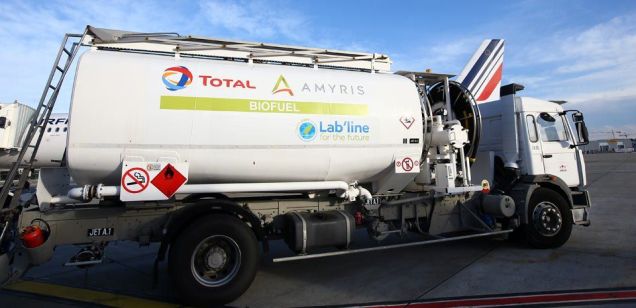 Amyris, the U.S. industrial bioscience company, has won a three-year multi-million dollar contract from the U.S. Department of Energy (DOE) to further the manufacturing of cellulose-derived farnesene for biofuels. The company led by John Melo, in cooperation with Renmatix and Total New Energies USA, will work to develop a manufacturing-ready process utilizing wood as the cellulosic feedstock to produce farnesene, a hydrocarbon building block used to manufacture a variety of products ranging from cosmetics to detergents, as well as base oils, lubricants, diesel and jet fuel.
 IL BIOECONOMISTA