Neste and Scania are piloting a digital solution that enables easy follow-up and verification of each truck’s usage of renewable fuels. Combining data from Scania Fleet Management Portal enriched with Neste’s fuel emission data, the solution provides Scania’s fleet management customers with accurate, up-to-date data for their greenhouse gas emissions (GHG) reporting and sustainability communications, both companies claim. Customers can compare the climate impact of their use of Neste’s renewable fuels to fossil fuels and track their continuous progress towards climate targets.
AFYREN, a greentech company that offers manufacturers bio-based, low-carbon ingredients produced using unique fermentation technology based on a completely circular model, and CEARITIS, a sustainable agriculture start-up, have signed a partnership to support the development of an innovative biocontrol device to protect orchards.
The two companies, which share the same values and commitment to environmental sustainability, have joined forces to offer tree-crop growers an innovative and biodiversity-friendly alternative to insecticides.
At the IPPE fair in Atlanta, BASF and Cargill announced their expanded cooperation, adding the United States (US) to their existing feed enzymes development and distribution agreement. Together, the two companies are committed to bringing innovative enzyme-based solutions to the market, generating distinctive value for animal feed customers. By combining the enzyme research and development strengths of BASF with Cargill’s know-how in application and broad market reach, the partners will form a joint innovation pipeline for animal protein producers.
Henkel and Shell Chemical LP have agreed to a five-year collaboration to replace up to 200,000 tonnes of fossil feedstocks used in the manufacture of surfactants with feedstocks that are based on renewable raw materials. The renewable-based surfactants will be used in Henkel’s laundry product brands, including many varieties of Persil®, Purex® and all® brands. Surfactants are an ingredient in cleaning products that help lather and lift dirt.
Avantium N.V., a leading technology company in renewable chemistry, and Henkel, a global leader of adhesives, sealants and functional coatings, and leading manufacturer of well-known consumer brands, signed an offtake agreement for five years, under which Avantium will supply Henkel with FDCA (furandicarboxylic acid) produced in Avantium’s FDCA Flagship Plant, currently under construction in Delfzijl, the Netherlands. Avantium expects to start production at this world’s first commercial facility for the production of FDCA from plant-based sugars in 2024.
Finnish company Valmet will deliver boiler conversions and emission reduction solutions for Veolia Group’s Hungarian subsidiary CHP-Invest Kft at its power plant in Oroszlány, Hungary. The order includes the conversion of two coal-fired boilers to bubbling fluidized bed combustion to enable the boilers to run mainly on biomass fuel. The order is included in Valmet’s orders received of the fourth quarter 2022. The value of the order is approximately 25 million euros. The converted boilers will be handed over to the customer in the first and second quarter of 2024.
thank you very much, again. 2022 was another great year for Il Bioeconomista, which continues to be considered as the most authoritative blog at world level. The bioeconomy is increasingly a phenomenon that attracts the attention of global public opinion and gratifies us as journalists, observers of a reality that we have always defined as the industrial revolution of the Third Millennium.
Today, a little more than 10 years since its foundation, we can say that Il Bioeconomista confirms itself as the world’s leading blog on bieconomy. Thank you so much. Our readers are mainly Europeans, but a growing number of readers are from the United States, Turkey, Canada, Brazil, India, Australia and Malaysia.
For us, it’s a tremendous encouragement to move forward, to offer you a blog that informs and promotes discussion on bioeconomy. The year that has just ended was very important for the global bioeconomy, with significant progress in terms of industry, research and awareness of the institutions, with the launch of the US National Biotechnology and Biomanufacturing Initiative.
We are sure that 2023 will be another important year for the implementation of the bioeconomy. We will be again on your side to tell the facts and continue growing.
Evonik has launched a non-animal-derived squalene suitable for vaccines and other pharmaceutical applications. PhytoSquene® is the first known amaranth oil-derived squalene on the market for use in adjuvants in parenteral dosage forms. It meets the demand for a secure commercial supply of non-animal-derived squalene. Non-GMP samples of PhytoSquene® are available immediately with GMP quality to follow in 2023.
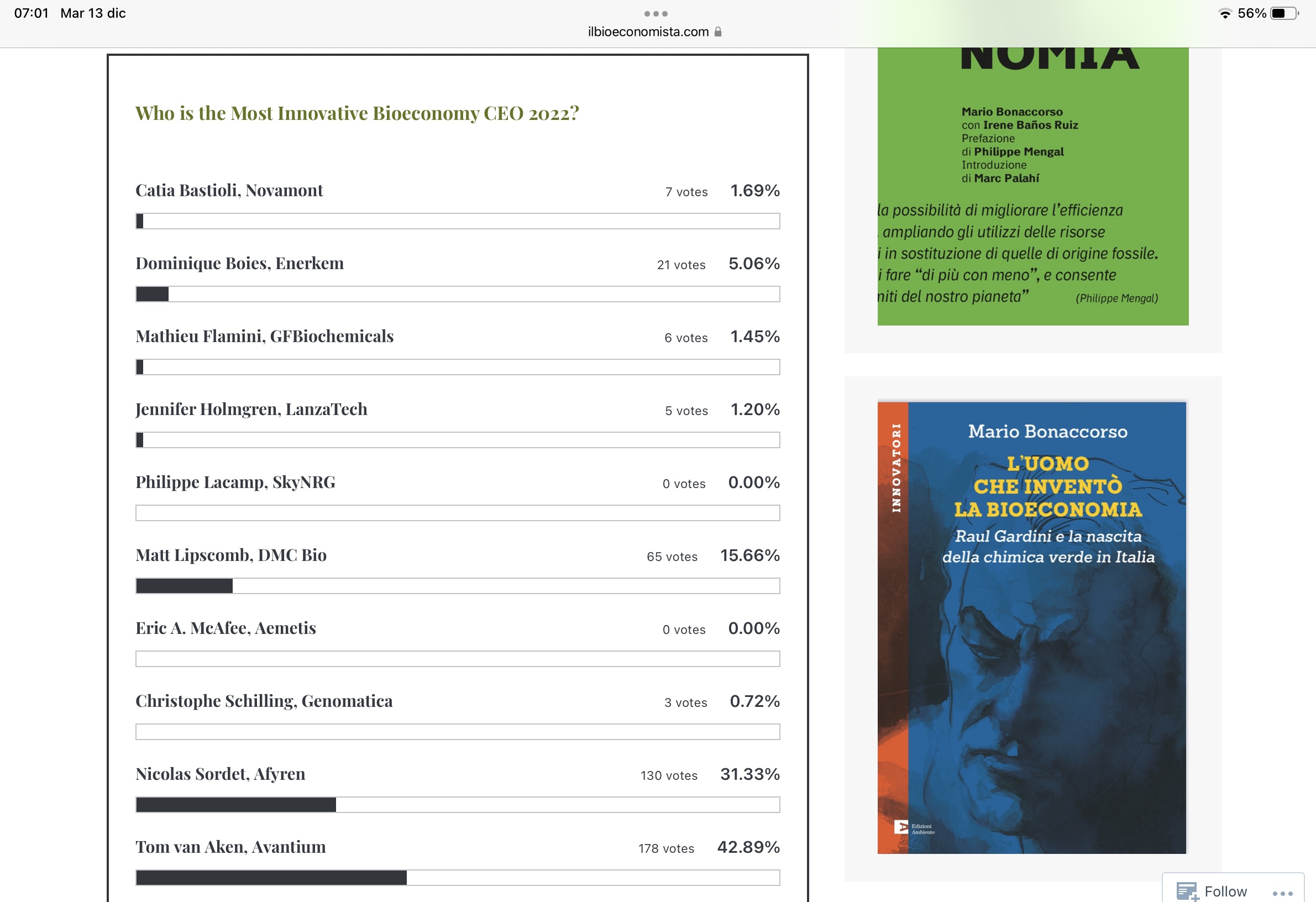
Our readers have voted. The most innovative bioeconomy CEO 2022 is Tom van Aken, CEO of Avantium, the Dutch company that is a pioneer in the emerging industry of renewable and sustainable chemistry. Avantium is headquartered in Amsterdam, employing approximately 200 people, with extensive R&D laboratories and three pilot plants in Geleen and Delfzijl, the Netherlands.
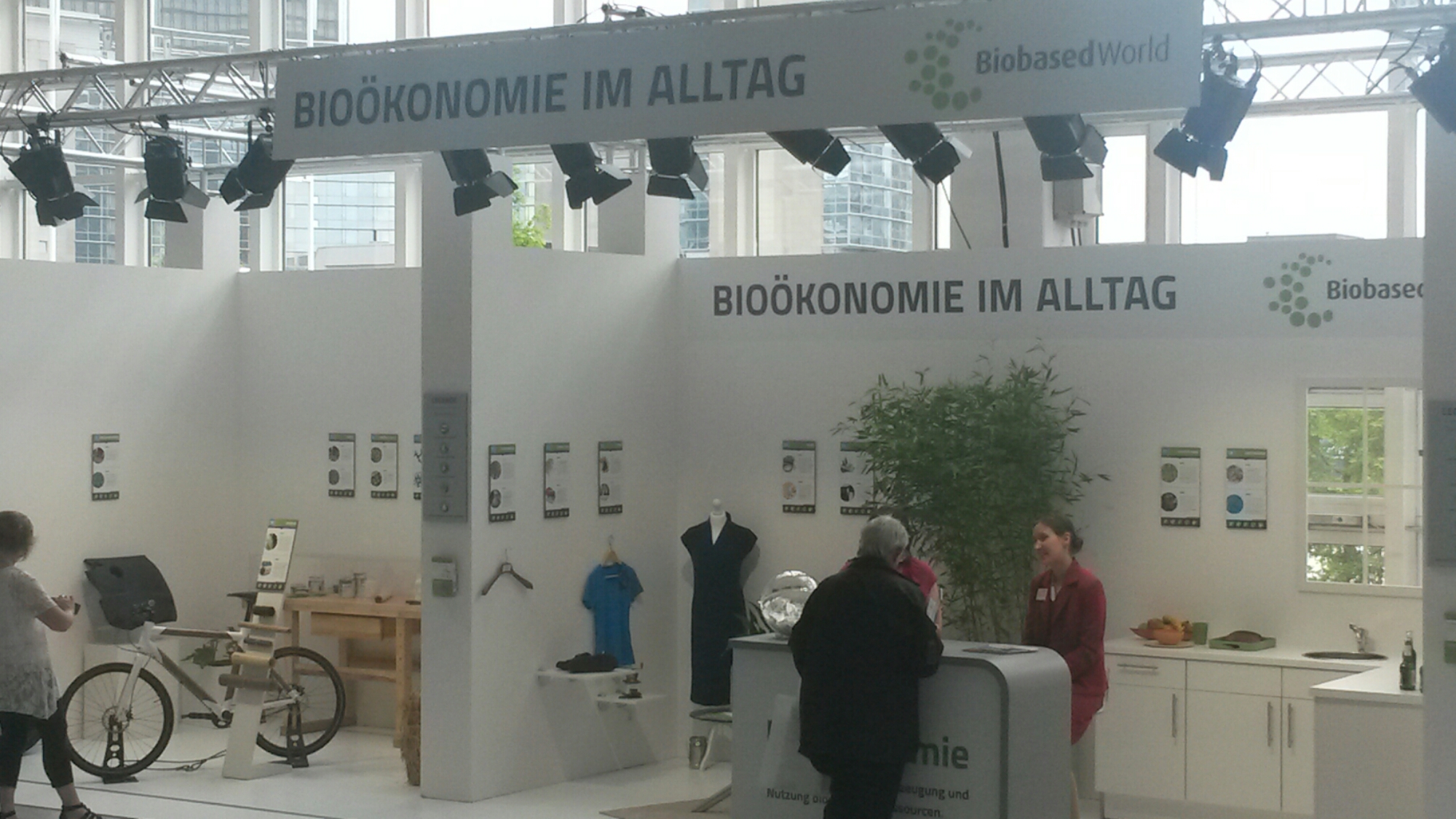
“Bioeconomy in everyday life” @ BioBased World 2015 in Frankfurt am Main
The circular bioeconomy is innovation, the result of the skills and passion of researchers and managers able to create value and new high-qualified jobs, reconciling economy, society and the environment. At the end of 2014 Il Bioeconomista launched a new initiative: The 10 Most Innovative Bioeconomy CEOs.
We have asked a panel of world bioeconomy experts to tell us the Chief Executive Officers that have stood out as the most innovative during the last year.
Now we ask you to choose the most innovative CEO responding to our survey (open till December 13 at 7 am, Western European Time).
The most innovative CEO 2016 was Ken Richards (CEO of Leaf Resources, Australia)
The most innovative CEO 2017 was Tony Duncan (CEO of Circa Group, Australia)
The most innovative CEO 2018 was Jürgen Eck (CEO of BRAIN AG, Germany)
The most innovative CEO 2019 was Alex Michine (CEO of MetGen, Finland)
The most innovative CEO 2020 was Simão Soares (CEO of SilicoLife, Portugal)
The most innovative CEO 2021 was Jennifer Holmgren (CEO of LanzaTech, USA)
This is the result of 2022 (in alphabetical order)