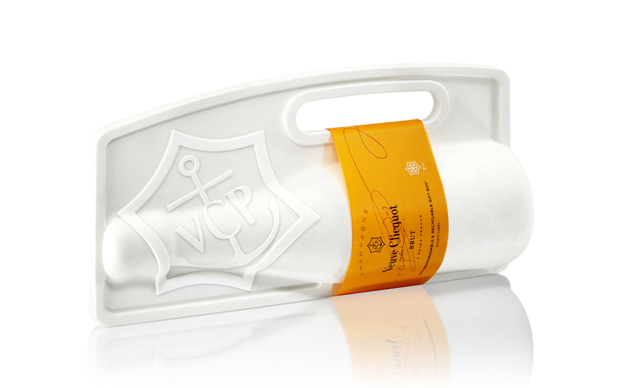
PaperFoam , a young and innovative packaging company based in the Netherlands and specialized in biobased packaging solutions with very low carbon footprint, won the DieLine Sustainable Packaging Award 2015 for its Naturally Clicquot 2, an eco-packaging design solution made from PaperFoam material for champagne producer Veuve Clicquot.
AkzoNobel has finalized the €153 million divestment of its global paper chemicals business to Kemira. The deal was first announced in July 2014.
“This is another important step in our strategy to focus on leading positions in bleaching chemicals, colloidal silica and expandable microspheres,” says Niek Stapel, Managing Director Pulp and Performance Chemicals. “The deal includes an agreement for distribution of colloidal silica to the paper industry and we are looking forward to future growth of this product line.”
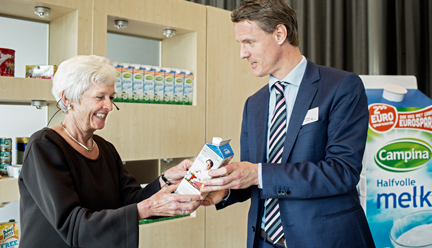
Berndt Kodden hands the first bio-based milk carton to Jacqueline Cramer
FrieslandCampina, one of the world’s five largest dairy companies with annual revenue of 11.3 billion euro, plans to introduce a new bio-based beverage carton over the next 1.5 years, starting with fresh milk and buttermilk from Campina in June 2015. For the production of the cap and the coating certified organic waste material is purchased. The paper in the carton was already renewable and this innovation makes it – Dutch company says – the most sustainable beverage carton ever. The CO2 footprint of this bio-based milk carton is 20% lower than the current carton. This is a scoop on the Dutch market.
A draft law to cap crop-derived biofuel production and accelerate the shift to alternative sources was voted by Parliament on Tuesday. It aims to cut greenhouse gas (GHG) emissions caused by the growing use of farm land for biofuel crops. Parliament has been calling since 2008 for the ILUC factor to be taken into account in EU biofuels policy, while biofuels grown on farm land have received up to €10 billion per year in public subsidies.
Global packaging is expected to be a USD 975 billion industry by 2018 with an annual growth rate of 4% which is a key driver for the use of bioplastics. In addition, numerous countries across the world implementing stringent regulations for the use of bio-based polymers for packaging is expected to fuel market growth over the next six years. To say this is a new report published by Grand View Research, Inc., a market analysis company based in California.
Bayer MaterialScience, a Bayer Group company among the world’s largest polymer companies with 2014 sales of 11.7 billion euro, is introducing a range of waterborne, bio-based polyurethane (PU) dispersions under the Impranil® eco name. With a renewable content that reaches as high as 65 percent, this product class contributes to a further reduction of CO2emissions, thus further improving the sustainability of waterborne PU. The products are part of the INSQIN® program for waterborne PU for textiles.
According to Reuters, EU antitrust regulators have raided several bioethanol companies suspected of fixing prices and at the same time stepped up their two-year investigation into possible rigging of biofuel price benchmarks by including a company in Spain in the case.
Kuraray expands into bio-based barrier materials through the acquisition of Plantic.
The Japanese chemical company was the first to commercialize the high-performance barrier resin, EVAL (ethylene vinyl alcohol copolymer), which it launched in 1972. EVAL boasts the highest level of gas barrier properties of all plastics and is the market leading barrier resin used in food packaging and industrial barrier applications. In addition Kuraray has developed and launched KURARISTER a transparent barrier film for retort applications.
Amyris, Inc., a global renewable products company providing sustainable alternatives to a variety of non-renewable resources, and Squalan Natural Health B.V., a privately held, personal care product company based in The Netherlands, have entered into agreements for the production and marketing of Neossance Squalane-based personal care products.
The partnership between Amyris and Squalan accelerates development and market penetration of skin care and personal care products containing Amyris’s Neossance Squalane, which is produced from plant sugars. Under this new relationship, Squalan will market and sell Neossance-based products to retailers and consumers, primarily in the European Union.
With less than one month to go before the official opening of Milan Expo 2015, almost nine million tickets have already been sold and organizers say the event is set to shine. The food-themed universal exposition runs from May 1 through October 31 with a record 53 single-nation pavilions, along with nine clusters representing about 90 countries and theme-based pavilions. About 140 countries in all will participate in Milan Expo 2015, under the theme: Feeding the Planet, Energy for Life. Some 20 million visitors are expected to join in on events that are based on promoting a sustainable global food system and fighting hunger. All these visitors will support the bioeconomy. Why?




 IL BIOECONOMISTA