There is a new partnership in the world bioeconomy. Indian Oil Corporation Limited, India’s flagship national oil company and, LanzaTech, carbon recycling company based in Illinois, signed a Statement of Intent to construct the world’s first refinery off gas-to-bioethanol production facility in India.
Italian oil giant Eni, the City of Turin, GTT (Gruppo Torinese Trasporti) and Amiat, an Iren Group company, have signed an agreement to launch a large-scale experimental project with Turin buses using Eni Diesel+, the new Eni fuel with a 15% of renewable component. Under the agreement, the Turin public transport company will pay Eni Diesel+ at the same price as the diesel fuel that its vehicles have used on the urban network up to now. This follows Eni’s success at the tender to supply the fuel for Turin’s buses.
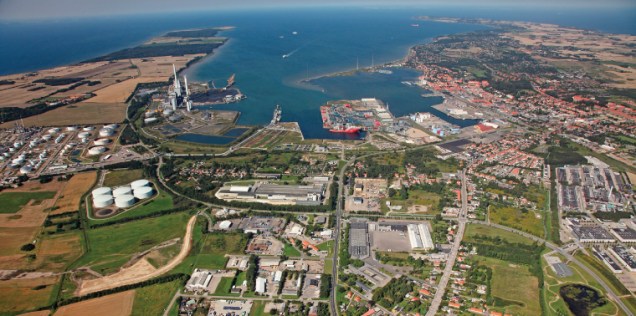
Aerial view of Kalundborg sustainable industry complex
Novozymes, Novo Nordisk, Kalundborg Forsyning and DONG Energy signed a new 20-year agreement which enables Denmark’s largest coal-fired power station unit, the Asnæs Power Station, to phase out coal and replace it with wood chips. Novozymes sources steam from the power station.
“The UK cannot solve the problem on its own, and we will need to collaborate with foreign governments and companies if we are to truly tackle the crisis ahead.” To say it referring to Brexit – in this exclusive interview with Il Bioeconomista – is Jaymin Amin, COO at Ingenza, the spin-out from the University of Edinburgh founded in 2002, which is today one of the most dynamic European industrial biotech company. With Amin we talk about industrial biotechnology and bioeconomy in Scotland.
The Metsä Group’s bioproduct mill start-up will begin in mid-August, and pulp deliveries from the new mill to customers will begin in early September. The current pulp mill at Äänekoski – the company announced – will be shut down once the bioproduct mill starts up.
Queensland Premier Annastacia PalaszczukAmyris, the U.S. industrial bioscience company, and the Government of Queensland, Australia, announced the next step their plans to develop a leading industrial biotechnology hub in Southeast Asia. Plans call for developing a new production plant with support from local partners to produce Amyris’s sugar cane-based ingredient called farnesene, which is used in products including cosmetic emollients, fragrances, nutraceuticals, polymers, and lubricants.
ExxonMobil, the largest publicly traded petroleum and petrochemical enterprise in the world, and Synthetic Genomics Inc., a global leader in the fields of synthetic biology and synthetic genomics, achieved a breakthrough in joint research into advanced biofuels involving the modification of an algae strain that more than doubled its oil content without significantly inhibiting the strain’s growth.
Catia Bastioli at the Grand Opening of Mater Biotech, 30 September 2016The European bioeconomy has its own manifesto. Catia Bastioli, CEO of Novamont, makes it available with her publication “A circular approach to bioeconomy” published by Edizioni Ambiente, the leading Italian publisher on environmental issues. This is a real action plan that involves all of us as consumers and, first of all, as citizens and people, starting from the successful case of the company headquartered in Novara and, as Bastioli recalls in the subtitle, offers a great “opportunity to decarbonise the economy and reconnect it with society “.
Bioindustrial Innovation Canada (BIC) has made a COMM SCI (Centre for Commercialization of Sustainable Chemistry Innovation) investment, whose amount wasn’t disclosed, in Origin Materials through BIC’s Sustainable Chemistry Alliance (SCA) investment fund, as part of an investment round that will see Origin construct its first commercial scale demonstration facility in Sarnia (Ontario) by late 2018.
“GRowing Advanced industrial Crops on marginal lands for biorEfineries” (GRACE): this is the name of the BBI demonstration project under the coordination of the University of Hohenheim in Stuttgart (Germany) and with a unique consortium made up of universities, agricultural companies and industry. The aims will be achieved by knowledge exchange between these groups, together with new crop varieties and cultivation experiments on areas that have been polluted by heavy metals, for example, or are unattractive for food production due to lower yields.




 ExxonMobil, the largest publicly traded petroleum and petrochemical enterprise in the world, and Synthetic Genomics Inc., a global leader in the fields of synthetic biology and synthetic genomics, achieved a breakthrough in joint research into advanced biofuels involving the modification of an algae strain that more than doubled its oil content without significantly inhibiting the strain’s growth.
 Bioindustrial Innovation Canada (BIC) has made a COMM SCI (Centre for Commercialization of Sustainable Chemistry Innovation) investment, whose amount wasn’t disclosed, in Origin Materials through BIC’s Sustainable Chemistry Alliance (SCA) investment fund, as part of an investment round that will see Origin construct its first commercial scale demonstration facility in Sarnia (Ontario) by late 2018.
 IL BIOECONOMISTA