Marginal lands are prime fuel source for alternative energy

bioetanolo distributoreMarginal lands ­– those unsuited for food crops – can serve as prime real estate for meeting the nation’s alternative energy production goals.

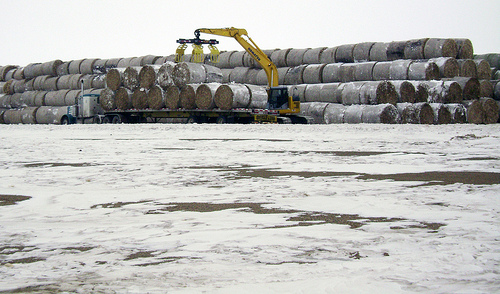
In the current issue of Nature, a team of researchers led by Michigan State University shows that marginal lands represent a huge untapped resource to grow mixed species cellulosic biomass, plants grown specifically for fuel production, which could annually produce up to 5.5 billion gallons of ethanol in the Midwest alone.

“Understanding the environmental impact of widespread biofuel production is a major unanswered question both in the U.S. and worldwide,” said Ilya Gelfand, lead author and MSU postdoctoral researcher. “We estimate that using marginal lands for growing cellulosic biomass crops could provide up to 215 gallons of ethanol per acre with substantial greenhouse gas mitigation.”

Continue reading

In Sardinia the first Italian start-up that develops biopesticides

agricoltura sardegna“The landing in a sustainable agriculture is one of the major challenges of the third millennium, with a major impact on the health of humans and animals, biodiversity and the balance of the entire ecosystem.” To say it in this interview is Luca Ruiu, a researcher at the University of Sassari, founder and CEO of Bioecopest, a spin-off of the same university that develops natural biopesticides, “antagonistic microorganisms harmful for pests you want to eradicate from crops, but absolutely harmless for those who then goes to eat fruit and vegetables treated in this way.” With Ruiu we talk on biopesticides, sustainable agriculture and bioeconomy as a driver for the economic growth and the creation of new high-skilled employment.

Interview by Mario Bonaccorso

Continue reading

Another brick in the European Bioeconomy’s wall

dublin castleAnother brick towards the European Bioeconomy. The European Commission organises from 14 to 15 February in Dublin the conference “Bioeconomy in the EU: achievements and directions for the future”.

One year on from the launching of the EU’s Bioeconomy Strategy, Brussels in collaboration with the Irish Presidency analyses the achievements and the opportunities ahead in the two-day conference.

Commissioner for Science, Research and Innovation, Máire Geoghegan-Quinn, and the Irish Minister for Agriculture, Food and the Marine , Simon Coveney, will open this high level meeting that takes place in the Dublin Castle.

Continue reading

In Brussels to foster European bioeconomy

La sede della Commissione europea, BruxellesDear Readers,

we would like to draw your attention to the stakeholder event on the planned bio-based industries PPP (Public-Private Partnership) BRIDGE organised by the European Commission DG Research on 09 January 2013 in Brussels.
During this event, the Commission will present the results of the public consultation, which ran until mid-December; and several partners active in the PPP will present the vision and mission of BRIDGE. The stakeholder meeting will be opened by DG Robert-Jan Smits, followed by presentations from Stephan Tanda (DSM), Catia Bastioli (Novamont), Tini Hooymans (TNO) as well as a panel discussion with representatives from the EU Commission, Industry and RTOs moderated by Lars Hansen (Novozymes).

Continue reading

Evonik: the future of Chemical industry is eco-sustainable

“The chemical industry has the potential to play a key role in a sustainable economy. Already in this particular economic phase, the use of alternative feedstock in the chemical industry is gaining importance in light of increasing oil prices and finite fossil resources”. To say it, in this interview with Il Bioeconomista is Achim Marx, top manager of Evonik with the responsibility to follow the business of the Bioeconomy, together with his collegue Henrike Gebhardt, Senior Project manager for bioeconomy. To many people the name Evonik will bring to mind the main sponsor of Borussia Dortmund, the German football team that in its qualifying round of the Champions League has left behind great teams such as Real Madrid, Manchester City and Ajax. The company based in Essen is one of the world’s largest industrial chemical groups: 33 thousand employees around the world with a turnover of about 15 billion euro. His business is in specialty chemicals, real estate and energy.

Interview by Mario Bonaccorso

Evonik is one of the major chemical group in Europe that invests strongly in bioeconomy. What’s the role of biological resources for the sustainability of the chemical industry?

AM: In my opinion the chemical industry will remain primarily petrochemical-based until roughly 2030 to 2050, due primarily to the cost and limited availability of biomass. Nevertheless, using renewable raw materials such as sugar or plant waste reduces producers’ dependence on petrochemical feedstocks, thereby ensuring access to raw materials. Critical here is that biotech and chemical processes both be economical. Sustainability of a given biological process has to be verified as well. Evonik delivers high-performance products to its customers. An important performance attribute is sustainability, and the life cycle assessment characteristics for Evonik’s amino acids and bio-based polyamides are outstanding. Another important benefit to the customer is global supply security. Our customers highly value Evonik’s global amino acid supply network and long tradition of using industrial biotechnology for large-scale production of feed amino acids. The use of alternative feedstock in the chemical industry is gaining importance in light of increasing oil prices and finite fossil resources. Although our industry will remain predominantly petrochemical-based in the coming decades, there is enormous potential for increasing the use of bio-based feedstock—not only for producing specialty chemicals but also as the key building blocks of high-volume chemicals. The ability of all the actors to go the full innovation cycle – from research to market deployment – will be a key factor in determining success.

And for the future of a reality such as Evonik?

AM: Biotechnology is a future-oriented technology and, therefore, an integral part of Evonik’s growth strategy. Evonik has been active in the bioeconomy for decades. Our company’s portfolio comprises amino acids and derivatives, active pharmaceutical ingredients (APIs), (bio)catalysts/products for the production of biofuels and platform chemicals, bio-based polyamides, bio-based polyester polyols for coatings/adhesives, active cosmetic agents, emollients, etc.

How much does Evonik invest in biotech R&D as percentage of the total turnover? What’s your plan on bioeconomy for the next years?

HG: With biotechnology, Evonik continuously improves the Group’s existing products, develops new products, and designs more efficient and sustainable manufacturing processes. Last year Evonik spent €365 million on research and development therefore more than €30 million in biotech R&D. In our Science-to-Business Center Biotechnology at the Marl site, Germany, research in “white biotechnology” focuses on two aspects: developing sustainable production processes such as fermentation and biocatalysis, and synthesizing bio-based materials that possess superior properties or present a significant cost advantage. The Science-to-Business Center Biotechnology is divided into four competence areas: Synthetic Pathways, Bio-Product & Process Development, Portfolio Development, and Networks Industrial Biotechnology. Currently, the Center devotes its research to the development of high-performance plastics, as well as to the manufacture of ingredients for cosmetics, such as anti-aging products. Projects of the Science-to-Business Center Biotechnology have been financially supported by the state of Nordrhein-Westfalen and co-financed by the European Union.

Meanwhile, you have also presented a development plan in the field of Health and Nutrition, right?

AM: Yes, Evonik’s Health & Nutrition business unit is active in biotechnological research and development. The business unit’s strengths are in metabolic engineering and in developing fermentative and enzymatic production processes. The Process Technology & Engineering service unit provides Health & Nutrition with support for designing processes and building facilities and facility components. In addition, Health & Nutrition operates a global network of production facilities of varying size, scope and specialization. They allow us to make specialty products for the pharmaceutical industry as well as high-volume products for nutrition applications. In the Health & Nutrition Business Unit alone Evonik is hoping for sales of €1 billion over the medium term for products made using biotechnology.

Give us some examples…

HG: Evonik will be investing some €350 million by 2014 to expand its Biolys® business. An amino acid used in animal feeds, Biolys® is a source of L-lysine produced via fermentation. Investments include construction of new L-lysine plants in Brazil and Russia capable of producing nearly 200,000 metric tons each year as well as a recently finished production expansion to 280,000 metric tons per year at its Blair site in North America. The new facilities are in line with the health and nutrition megatrends. As the world’s population grows, so does the demand for meat, fish, dairy, and eggs. As a consequence, feed production is increasingly relying on amino acids to supplement feed. Biolys®,a biotechnology product made from renewable resources, is globally known as a highly effective source of L-lysine for animal feed, which helps sustainably reduce costs in feed production and animal breeding. It also benefits the environment: in a life-cycle analysis certified by TÜV Rhineland, Evonik documented that supplementing the protein supply in animal feed with Biolys® is a particularly environmentally sound concept for adequate, healthy animal nutrition.

As far as Evonik’s concerned, is the Bioeconomy, together with Green Economy, the right answer to the challenges of the third Millennium?

AM: Developing a “green economy” was one of the key topics at the Rio+20 Conference, and with good reason. I feel that both issues – sustainability and efficiency – are important concerns for bio-based chemicals and are in no way contradictory. A sustainable economy does indeed need to look at the possibility of increasing bio-based elements. The chemical industry has the potential to play a key role in a sustainable economy. Evonik specialty chemicals activities focus on high-growth megatrends. The megatrends resource efficiency, health and nutrition, and globalization are the translation of the future needs of a growing, ageing, and global population. The Bioeconomy will have a key role in supporting the development of innovative products and technical solutions to answer these challenges.

(the Italian version of this interview is published on affaritaliani.libero.it/green)


DSM: in Europe we need a more integral approach to the bioeconomy from regulators

In Europe there is a need for stability and coherence in the regulatory field of new energy. The Commission’s decision to limit to 5% the use of first-generation biofuels (those derived from food crops) goes in the wrong direction. To say it is Martijn Antonisse, director of new projects on bio-based products for DSM, the giant Dutch multinational active in the fields of life sciences, nutrition and materials (22 thousand employees worldwide, with a turnover of € 9 billion in 2011) . One of the first industries to sniff the new business of bio-economy, the new economy based on biological resources, and invest good money.
Mister Antonisse, how much is DSM investing for bio-based products?
We don’t reveal our R&D expenditure for any specific subject. What we can share is that we spent 5.3% of net sales on R&D in 2011
Well, I think a significant percentage. But what makes DSM so decided to focus on the bioeconomy?
We don’t know exactly what the future holds for our planet, but we strongly believe that we need to prepare for the era when fossil feedstock will become too expensive, or even limited in availability. As our great-grandparents and their ancestors did, we will need to return to living of the land – using wind, solar energy, hydro and crops, be it smarter (a/o through the use of biotechnology) than we did before we found oil.
According to Bloomberg New Energy Finance, next-generation ethanol alone could create up to a million man-years of sustainable employment in Europe between now and 2020, and help reduce road transport green house gas emissions by 50%.
DSM wants to be a leader of this revolution. Thanks to our company, new enzyme and yeast technology exists that has made cellulosic ethanol – that is biofuel made from (non edible) plant residues– commercially viable for the first time.
So what do you think of the European Commission’s decision to restrict the use of first-generation biofuels to 5%? The discussion in the whole of Europe is lively …
The proposal to limit the use of crop-based biofuels to 5% and at the same time double or quadruple count several non-food-related alternatives, will eventually lead to a lower percentage of current fuel consumption being fulfilled with renewable alternatives. To us that is a disappointing direction, since we work from the belief that the transition from non-renewable to renewable feedstock is the first important objective. Regulation should help to increase the level of responsible thinking involved – not stop, or limit the demand.
What measures should be introduced by Europe to effectively drive the bioeconomy?
DSM feels that we need a) a more integral approach to the bio-economy from regulators (rather than one-sided thinking, either from energy, or agricultural, or environmental perspective) and b) measures that create a more level playing field for bio-based solutions versus their alternatives that are based on non-renewable feedstock. In this sense, we feel that Europe is severely lagging behind the USA and Brazil when it comes down to supportive policies and (consequential) market conditions.
Fortunately, however, DSM is not investing only in the U.S. or Brazil. It also does in Italy: in Cassano Spinola in the province of Alessandria, there is a plant of Reverdia, your joint venture with Roquette
Today the vast majority of chemical building blocks that go into making foods, resins, polymers and pharmaceuticals are derived from oil.
In a first significant step away from this model, DSM has partnered with Roquette, a leading French starch and starch-derivatives company, to produce bio-succinic acid, a key chemical building block that is made from plants rather than fossil carbon sources.
Bio-succinic acid, which is made from starch using an innovative enzyme-based fermentation technology, has environmental benefits in two respects: not only does it avoid the need for non-renewable hydrocarbon ingredients; it is also much less energy intensive to produce, requiring 40% less energy to make than conventional succinic acid.
Mario Bonaccorso

Green o Bio, benvenuti nella nuova economia

Bioeconomy, Green Economy. Che sia Bio o che sia Green, l’economia di questo nuovo millennio non potrà più essere come l’abbiamo conosciuta fino ad oggi: dovrà utilizzare le risorse biologiche e le energie pulite per essere sostenibile. Potremmo forse solo dire Economia, nella consapevolezza che dalla strada intrapresa non si può tornare indietro. Fra qualche decennio – ci auguriamo – non ci sarà più bisogno di aggettivi. In questo senso gli Stati Generali della Green Economy che si sono tenuti a Rimini dal 7 all’8 novembre sono una buona notizia anche per la Bioeconomy, perché non solo si sono occupati delle energie da biomasse ma soprattutto hanno tracciato una direzione condivisa verso una società post-petrolifera. La presenza del ministro dell’Ambiente, Corrado Clini, e del ministro dello Sviluppo economico, Corrado Passera, danno un segnale importante che almeno a Palazzo Chigi in questo momento ci sono gli interlocutori giusti. Certo non è ancora sufficiente.

La bioeconomia non è solo una questione industriale o finanziaria, ma è anche e probabilmente in modo rilevante una questione culturale: riguarda la nostra vita di tutti i giorni, le nostre abitudini consumistiche.

Allora è un bene che come proposto a Rimini si cominci a ragionare su una pedonalizzazione di tutti i centri urbani, che si avviino o si consolidino tutte le iniziative di bike-sharing, car-sharing e car-pooling. Che si sostenga una politica di lotta allo spreco e di riutilizzo dei rifiuti. La mobilità sostenibile e la gestione dei rifiuti fanno parte integrante anche della bioeconomia, intesa come movimento culturale.

E molte delle 70 proposte, estratte dai documenti elaborati dagli 8 gruppi di lavoro tematici, che sono state oggetto di dibattito e di confronto con gli interlocutori intervenuti agli Stati generali della Green Economy sono applicabili integralmente alla bioeconomia.

Vediamole nel dettaglio: misure generali per una green economy (tra cui l’obiettivo di migliorare e rafforzare la comunicazione agli investitori e ai mercati sui vantaggi della green economy, valorizzare il potenziale green delle imprese italiane, rafforzare un uso mirato degli strumenti economici, promuovere e sostenere iniziative green oriented nell’ambito del venture capital e del private equity); sviluppo dell’ecoinnovazione, sviluppo dell’ecoefficienza, del riciclo e della rinnovabilità dei materiali, sviluppo dell’efficienza e del risparmio energetico; sviluppo delle fonti energetiche rinnovabili, tutela e valorizzazione dei servizi degli ecosistemi, sviluppo delle filiere agricole di qualità ecologica e sviluppo di una mobilità sostenibile.

Adesso attendiamo che queste proposte siano tradotte in provvedimenti concreti e che accanto al Piano nazionale per la Green Economy annunciato dal ministro Clini a Rimini ci sia anche un Piano per la Bioeconomy. D’altronde che sia Bio o che sia Green stiamo sempre parlando dell’Economia del Terzo millennio.

MB