 Waste can be base of new bioplastics. There are many waste resources hidden in our communities. Municipal solid waste (MSW), agricultural residues and sewage sludge from water treatment plants contains lots of reusable carbon fractions. To recover them means recovering a valuable product as well as preserving the environment. The European Commission is working in order to develop the Synpol (“Biopolymers from syngas fermentation”) project, that is funded under the Food, agriculture and fisheries, and biotechnology Theme of the EU’s Seventh Framework Programme (FP7) to the tune of € 7.5 million.
EU
La bioeconomia salverà il mondo? La missione è possibile. Al museo dei bambini di Roma
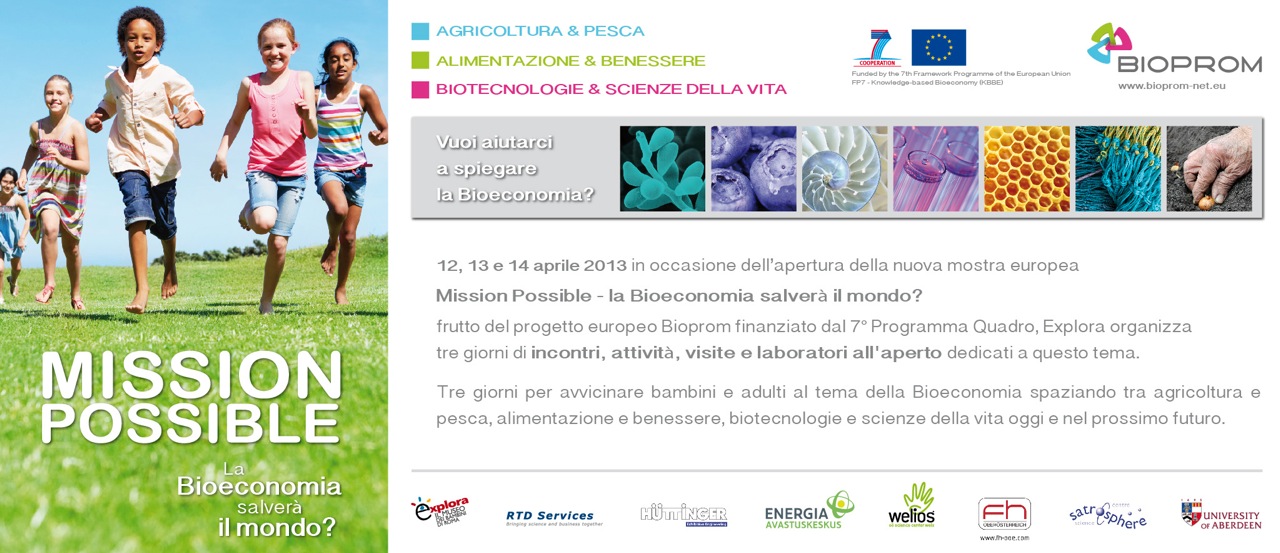 La Bioeconomia salverà il mondo? È il tema proposto dalla mostra che sarà inaugurata il 12 Aprile a Explora, il museo dei bambini di Roma.
Ricercatori ed esperti di musei e science centres europei – Austria, Estonia, Germania, Italia e Gran Bretagna – hanno collaborato al progetto, finanziato dal 7° Programma Quadro della Commissione europea.
“Mission possible” è una mostra interattiva che verrà inaugurata a Roma, prima tappa del tour europeo per far conoscere la Bioeconomia al grande pubblico.
A Dublino si discute il futuro della Bioeconomia in Europa
 È tutto pronto a Dublino per il via alla Conferenza degli stakeholders europei della bioeconomia (Bioeconomy in the EU: achievements and directions for the future – potete seguirla in diretta su Twitter @bioeconomista). Nella splendida cornice offerta dal castello che domina la capitale d’Irlanda, Istituzioni, imprese e centri di ricerca provenienti da ogni angolo del Vecchio Continente si confronteranno giovedì 14 e venerdì 15 febbraio sui prossimi passi da realizzare per mettere in atto la strategia per la bioeconomia lanciata lo scorso anno dalla Commissione europea.
Proprio a Dublino si festeggerà il primo anniversario della strategia, di cui principale protagonista è la commissaria alla Ricerca, Innovazione e Scienza, Máire Geoghegan-Quinn, chiamata a fare da padrona di casa in coincidenza con la Presidenza irlandese dell’Unione europea.
Danish BioRefining Alliance: “We need the EU to speed up and decide on a better regulation with targets for 2G biofuels”
 “By having the first full scale 2G biorefinery (Mossi & Ghisolfi’s Biorefinery in Crescentino, editor’s note) I am convinced that Italy will play one of the important and leading roles in 2G bioeconomy on a European level. We hope very much that the next full scale plant will be in Denmark.The EU countries have a unique chance to be first movers and preferred partners in the future global bioeconomy”. To say it, in this interview, is Anne Grete Holmsgaard, the director of the BioRefining Alliance, the Danish partnership organization working to promote 2G biofuels and bioeconomy in Europe. Denmark has a leading role in the European bioeconomy. With Anne Grete Holmsgaard we talk about BioRefining Alliance, but especially bioeconomy and European policies to foster it. “We need – says the BioRefining Alliance’s director – the EU to speed up and decide on a better regulation with targets for 2G biofuels, which will give a very clear signal to investors.
Interview by Mario Bonaccorso
Exclusive interview with European Commissioner Màire Geoghegan-Quinn: “We must prepare ourselves for a post-petroleum society”
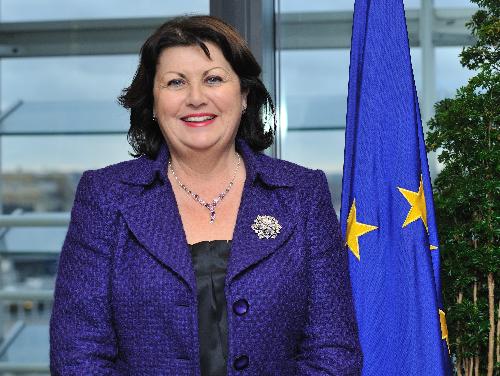
“Europe and the rest of the world must cope with an expected 70 per cent increase in food demand, and a 100 per cent increase in energy demand, by 2050. Under these circumstances, we must prepare ourselves for a ‘post-petroleum’ society, one in which we use our natural resources more sustainably”. In this exclusive interview European Commissioner for Research, Innovation and Science, Màire Geoghegan-Quinn, talks about bioeconomy and European policies to support it. And tells us that “The Italian government is aware of the benefits of a coordinated bioeconomy strategy and expressed interest in possibly hosting the annual Bioeconomy Stakeholders Conference in Italy in 2014”.
Interview by Mario Bonaccorso
Another brick in the European Bioeconomy’s wall
 Another brick towards the European Bioeconomy. The European Commission organises from 14 to 15 February in Dublin the conference “Bioeconomy in the EU: achievements and directions for the future”.
One year on from the launching of the EU’s Bioeconomy Strategy, Brussels in collaboration with the Irish Presidency analyses the achievements and the opportunities ahead in the two-day conference.
Commissioner for Science, Research and Innovation, Máire Geoghegan-Quinn, and the Irish Minister for Agriculture, Food and the Marine , Simon Coveney, will open this high level meeting that takes place in the Dublin Castle.
In Brussels to foster European bioeconomy
 Dear Readers,
we would like to draw your attention to the stakeholder event on the planned bio-based industries PPP (Public-Private Partnership) BRIDGE organised by the European Commission DG Research on 09 January 2013 in Brussels.
During this event, the Commission will present the results of the public consultation, which ran until mid-December; and several partners active in the PPP will present the vision and mission of BRIDGE. The stakeholder meeting will be opened by DG Robert-Jan Smits, followed by presentations from Stephan Tanda (DSM), Catia Bastioli (Novamont), Tini Hooymans (TNO) as well as a panel discussion with representatives from the EU Commission, Industry and RTOs moderated by Lars Hansen (Novozymes).
DSM: in Europe we need a more integral approach to the bioeconomy from regulators
 In Europe there is a need for stability and coherence in the regulatory field of new energy. The Commission’s decision to limit to 5% the use of first-generation biofuels (those derived from food crops) goes in the wrong direction. To say it is Martijn Antonisse, director of new projects on bio-based products for DSM, the giant Dutch multinational active in the fields of life sciences, nutrition and materials (22 thousand employees worldwide, with a turnover of € 9 billion in 2011) . One of the first industries to sniff the new business of bio-economy, the new economy based on biological resources, and invest good money.
Mister Antonisse, how much is DSM investing for bio-based products?
We don’t reveal our R&D expenditure for any specific subject. What we can share is that we spent 5.3% of net sales on R&D in 2011
Well, I think a significant percentage. But what makes DSM so decided to focus on the bioeconomy?
We don’t know exactly what the future holds for our planet, but we strongly believe that we need to prepare for the era when fossil feedstock will become too expensive, or even limited in availability. As our great-grandparents and their ancestors did, we will need to return to living of the land – using wind, solar energy, hydro and crops, be it smarter (a/o through the use of biotechnology) than we did before we found oil.
According to Bloomberg New Energy Finance, next-generation ethanol alone could create up to a million man-years of sustainable employment in Europe between now and 2020, and help reduce road transport green house gas emissions by 50%.
DSM wants to be a leader of this revolution. Thanks to our company, new enzyme and yeast technology exists that has made cellulosic ethanol – that is biofuel made from (non edible) plant residues– commercially viable for the first time.
So what do you think of the European Commission’s decision to restrict the use of first-generation biofuels to 5%? The discussion in the whole of Europe is lively …
The proposal to limit the use of crop-based biofuels to 5% and at the same time double or quadruple count several non-food-related alternatives, will eventually lead to a lower percentage of current fuel consumption being fulfilled with renewable alternatives. To us that is a disappointing direction, since we work from the belief that the transition from non-renewable to renewable feedstock is the first important objective. Regulation should help to increase the level of responsible thinking involved – not stop, or limit the demand.
What measures should be introduced by Europe to effectively drive the bioeconomy?
DSM feels that we need a) a more integral approach to the bio-economy from regulators (rather than one-sided thinking, either from energy, or agricultural, or environmental perspective) and b) measures that create a more level playing field for bio-based solutions versus their alternatives that are based on non-renewable feedstock. In this sense, we feel that Europe is severely lagging behind the USA and Brazil when it comes down to supportive policies and (consequential) market conditions.
Fortunately, however, DSM is not investing only in the U.S. or Brazil. It also does in Italy: in Cassano Spinola in the province of Alessandria, there is a plant of Reverdia, your joint venture with Roquette
Today the vast majority of chemical building blocks that go into making foods, resins, polymers and pharmaceuticals are derived from oil.
In a first significant step away from this model, DSM has partnered with Roquette, a leading French starch and starch-derivatives company, to produce bio-succinic acid, a key chemical building block that is made from plants rather than fossil carbon sources.
In a first significant step away from this model, DSM has partnered with Roquette, a leading French starch and starch-derivatives company, to produce bio-succinic acid, a key chemical building block that is made from plants rather than fossil carbon sources.
Bio-succinic acid, which is made from starch using an innovative enzyme-based fermentation technology, has environmental benefits in two respects: not only does it avoid the need for non-renewable hydrocarbon ingredients; it is also much less energy intensive to produce, requiring 40% less energy to make than conventional succinic acid.
Mario Bonaccorso
 IL BIOECONOMISTA